



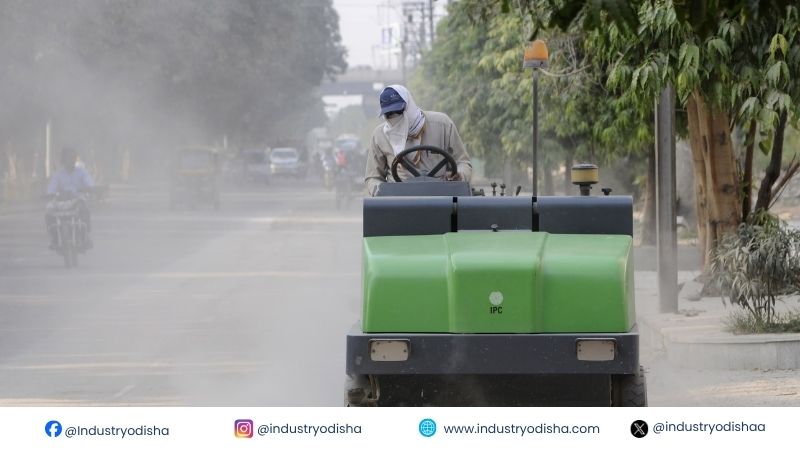
Industry Odisha Bureau, Oct 22: Dust loads on Indian roads run up to 30 times those of global cities. Road dust is linked to about 10,000 deaths yearly. Despite ₹16,500 crore in clean-air funds, cleaned roads soon turn dusty.
Winter smog dominates India’s air pollution debate, but road dust never goes away. Construction debris, broken roads and unpaved shoulders keep cities dusty all year. This silt crisis poses a quiet but stubborn obstacle to the country’s clean air goals. Mint’s ground report from Gurugram shows how deep the problem runs.
A 2024 study by researchers from IIT Delhi and IIT Kanpur measured the scale. It found silt loads on Indian roads 25–30 times higher than in developed countries. The team sampled 259 locations across 32 cities.
Silt load measures dust settled on a road, in grams per square metre. Traffic lifts that dust into the air as PM10 and finer PM2.5 particles. The IIT study said road dust makes up 30–60% of particulate levels in metropolitan areas.
A 2026 WRI India working paper studied roads in Mumbai, Ahmedabad and Indore. The highest readings were 19.7 grams per square metre in Ahmedabad and 6.8 in Mumbai. Indore peaked at 4.9 grams on its worst sampled stretch. Secondary data put Milan between 0.006 and 0.066 grams per square metre.
The accepted global benchmark is below 1–2 grams per square metre. These peaks reflect specific stretches, not citywide averages.
The researchers estimated about 10,000 deaths a year from road-dust-related PM2.5. The State of Global Air Report 2025 puts India’s air pollution deaths above two million. That broader figure covers every source, not road dust alone. Pulmonologist Arunesh Kumar said he increasingly sees COPD and asthma among non-smokers.
He also reported lung cancer in young non-smokers with no family history. Such observations do not tie individual illnesses to road dust alone. In Gurugram, shop worker Sumit Tayal spends five hours a day commuting on dusty roads. He blames uncovered trucks carrying debris and reports frequent coughing bouts.
Ruchika Sethi, founder of citizen group Clean Air Bharat, calls the sources local and controllable. She cites dumped construction waste, poor site controls and unpaved or dug-up roads.
Since 2019, the National Clean Air Programme (NCAP) has allocated nearly ₹16,500 crore. The money covers 130 cities, and WRI says over 60% goes to dust management. Environment ministry data for FY18 to FY25 show 64 cities cut PM10 emissions by 20%-plus. Only 22 had met the national PM10 standard of 60 micrograms per cubic metre.
WRI found dust returned to pre-cleaning levels within four to eight days. Sree Kumar Kumaraswamy of WRI said many Indian roads lack edge-to-edge paving. Exposed shoulders and heavy vehicles keep stirring dust back into the air. Dhirendra Singh of Airshed Planning Professionals said some vacuum sweepers release finer particles.
Mumbai mandated real-time monitoring at over 3,000 construction sites last May. Climate-tech firm Respirer Living Sciences links this to a 10–15% drop in pollution.
Sethi argues nothing will work unless dust is stopped at its source. The evidence points to full paving, tighter site controls and reliable street-level data.
