



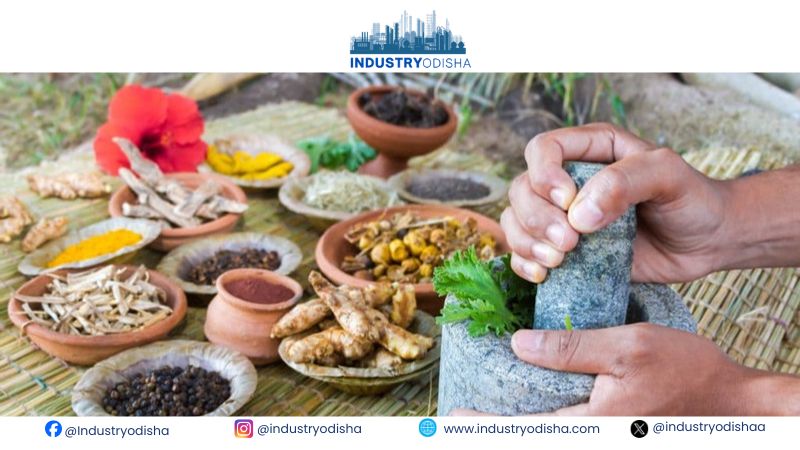
Industry Odisha Bureau, September 13: India’s Ayush market has surged past $43 billion, but experts say Ayurveda’s global future depends on evidence, standards and medical value travel, not heritage alone.
Ayurveda’s push for global relevance is entering a new phase. India already has deep domestic familiarity with Ayush systems. But international acceptance increasingly hinges on something else: credible scientific evidence.
Ayush Market Reaches $43.4 Billion
The numbers tell a striking growth story. India’s Ayush market expanded from $2.85 billion in 2014 to $43.4 billion in 2023. Ayush exports rose too, from $1.09 billion to $2.16 billion over the same period. Ayush covers multiple traditional systems, not Ayurveda alone. Still, the scale gives India a strong commercial base for international ambitions.
Research Becomes the Globalisation Test
Experts argue heritage alone cannot secure Ayurveda’s place in global healthcare. Stronger evidence, standardised practices and quality-assured products matter more now. Skilled professionals and globally compatible standards are also essential, said Professor Sanjeev Sharma of the National Institute of Ayurveda, Jaipur. The Ayush Research Portal already lists more than 43,000 research entries. That reflects growing research activity, though not proof of clinical effectiveness for every entry.
India’s Domestic Ayush Base
A government survey found extensive familiarity with Ayush systems. Rural awareness stood at 94.8%, urban awareness at 96%. Actual usage was lower: 46.3% in rural areas and 52.9% in urban areas over the preceding year. Ayurveda was the most commonly used Ayush system for treatment. Awareness, however, is distinct from proven medical effectiveness.
Ayush Visa Expands Medical Value Travel
India introduced a dedicated Ayush Visa in July 2023 for foreign nationals seeking treatment. This supports the government’s push into medical value travel. The global Medical Value Travel market was valued at $115.6 billion in 2022. A government backgrounder projects it could reach roughly $286.1 billion by 2030. That figure remains a forecast, not current market size.
WHO Framework Raises Visibility
The World Health Assembly adopted the WHO Global Traditional Medicine Strategy 2025–2034 last year. It focuses on evidence, safety, regulation and health-system integration. The WHO Global Traditional Medicine Centre, based in Jamnagar and established in 2022, has India as its lead investor. WHO has also added Ayurveda, Siddha and Unani to ICD-11’s Traditional Medicine Module 2. This aids international documentation, though it does not amount to clinical endorsement.
Standards Could Determine Global Growth
Dr Mamatha K V of SDM College of Ayurveda and Hospital said globalisation cannot rest on heritage alone. India must build internationally understandable standards while preserving Ayurveda’s core principles, she said. Research, education, sustainability and responsible medical tourism will shape long-term credibility.
India already has scale, awareness and institutional backing. The next challenge is converting that familiarity into an internationally credible, evidence-based healthcare offering.
