



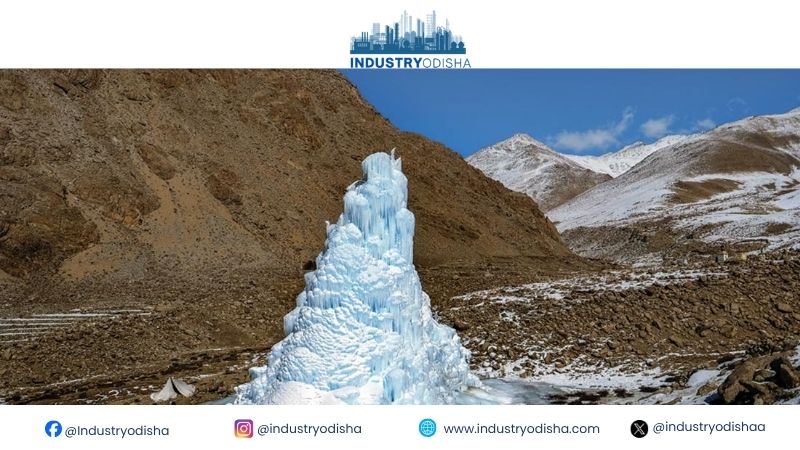
Industry Odisha Bureau, Aug 20: India is a land of diverse geographical landscape with the topography extended from uneven plateaus, the great Himalayas and rivers stretching across boundaries. The Himalayas, often called ‘abode of snow’ used to be snow-capped with the peaks touching clouds. However, studies over 120 years indicate the Western Himalayas are warming faster than the central and eastern regions.
The Western Himalayas comprise Ladakh, Jammu and Kashmir, Himachal Pradesh. Some important peaks in the region include Nanga Parbat (8,126 m) at the far western end. Nanda Devi (7,817 m), Kamet (7,756 m), and the twin peaks of Nun Kun (7,135 m) are some other tall peaks that comprise the Western Himalayas.
So is also the case with the mountains located in the Jammu & Kashmir region. Several reports suggest that the high-altitude that caused the Altitude sickness for the drop in the temperature has in fact warmed by nearly 1 degree Celsius.
The recent study revealed that the winters are becoming warm faster than the springtime. On the other hand, the night temperature is rising more than daytime.
This can be attributed to Snow-albedo feedback loop in case of both Western Himalayas and Jammu & Kashmir. The rise in temperature melts the seasonal snow rapidly, revealing the dark mountains under the snow cap. These dark surfaces absorb more heat acting as catalysts for the glacier melt. The increase in the moisture act as barriers for mountains from cooling down in that comparison.
However, the plains are sans the seasonal snow cover acting as a check against snow albedo feedback. The presence of habitation and expansion of irrigated agriculture are also aiding the rapid cooling of the plains in J&K. The drainage and soil moisture remove heat and giving a cooling effect.
If this climatic deformity continues, the temperature are expected to be 7.18°C warmer by the next century. This would be in the Western Himalayas, while the Central Himalayas will be 6.71°C and eastern Himalayas will be 5.82°C more.
The catastrophic effects of climate change like melting glaciers and the reducing snowfall will impact agriculture, horticulture, winter tourism, alpine ecosystems etc.
