



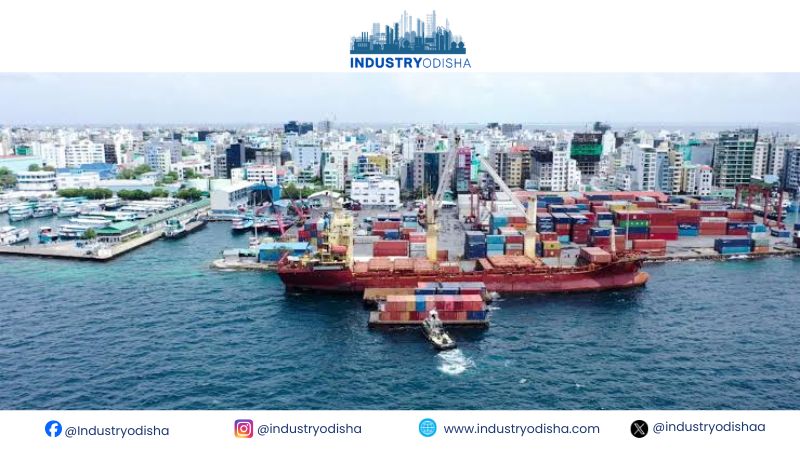
Industry Odisha Bureau, Sep 05: Maldives Ports Limited awarded Phase 1 of Thilafushi Port to CHEC. This Chinese firm received the contract on single-nomination basis. The Maldives had earlier planned joint development with India. This decision marks a significant infrastructure shift for Male. It carries strategic significance for India’s southern neighbourhood.
In 2024, President Mohamed Muizzu visited India for talks. Both sides announced plans to jointly develop Thilafushi Port. The stated purpose was decongesting the busy Male Port. The new Chinese MoU represents a departure from that arrangement.
China Harbour Engineering Company, or CHEC, secured the latest deal. Its parent company is China Communications Construction Company, or CCCC. CHEC has worked on Sri Lanka’s Hambantota Port previously. It has also handled projects across South America, Kenya and the Pacific.
These include Guyana’s Airport Project and Kenya’s Naivasha Inland Container Depot. The Nauru Port Redevelopment project is another CHEC undertaking. People familiar with the matter described CHEC’s track record as patchy. A strategic-affairs expert alleged CHEC projects have created various governance risks.
These risks reportedly span fiscal, environmental, political and strategic dimensions. Such claims remain attributed opinions, not independently established conclusions here. The Maldives sits within India’s southern neighbourhood strategically. This development could expand China’s infrastructure presence in the region.
The Maldivian economy currently faces a precarious financial position. The West Asian conflict has accentuated these existing economic pressures. Current-account and fiscal deficits are projected to increase substantially. GDP growth is expected to dip below 1% this year.
That marks a sharp decline from last year’s 6% growth. Despite this shift, India’s infrastructure role remains visible in Male. Muizzu recently praised India’s contribution to the Greater Male Connectivity Project. GMCP links Male with the industrial hub of Thilafushi.
Officials describe GMCP as the Maldives’ largest infrastructure undertaking yet. India has completed several infrastructure projects there over eight years. These projects have reportedly benefited several thousand Maldivian citizens directly. The Thilafushi decision does not necessarily end broader bilateral cooperation.
Instead, it reflects intensifying competition between India and China. Both nations continue seeking influence through infrastructure investment in Male. The outcome will likely shape regional connectivity and strategic dynamics across the Indian Ocean’s evolving infrastructure landscape in coming years.
