



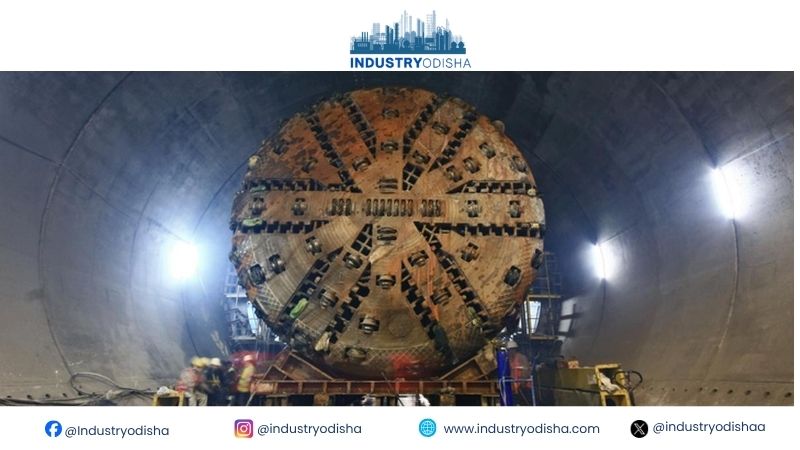
Industry Odisha Bureau, Oct 20: Beijing will impose export controls on tunnel-boring machines from 18 November, citing national security. The move could squeeze India, which imports these machines for metro, rail and border tunnels.
China has announced it will impose export controls on tunnel-boring machines (TBMs) and related items. The Commerce Ministry announced the step on 19 October; it takes effect on 18 November. Beijing will also adjust existing controls on certain dredgers and associated equipment.
An export control is not an outright ban. It usually requires exporters to obtain government licences before shipping covered goods.
The ministry cited national security and China’s international obligations, including non-proliferation. It said the covered items have “clear dual-use (civilian and military) characteristics”. Dual-use equipment serves civilian purposes but may also have military applications. Tunnelling machines, for instance, can dig metro lines or strategic underground facilities. China said it had notified countries with which it holds export-control dialogues. The controls apply to exports generally, not to any single country.
For India, the timing is awkward. The country depends on imports for TBMs. These giant machines bore through soil and rock to create tunnels. They are vital for urban metro networks and railway corridors. They also support key tunnelling projects, including in border areas. Any delay in procuring them can unsettle construction schedules and project planning.
Indian importers have already faced trouble since 2024. Customs clearance of TBMs from China has been repeatedly delayed. India has raised these delays with Beijing in the past. In October 2024, Commerce Minister Piyush Goyal raised it with German Vice Chancellor Robert Habeck. Goyal said China was blocking exports of TBMs made by a German company there. Foreign firms with Chinese factories must still follow Chinese export rules. Where a machine is built matters as much as who owns the maker.
Beijing also announced controls on certain drone technologies the same day. These include autopilots designed specifically for unmanned aerial vehicles (UAVs). Certain engines built for UAVs and unmanned airships are also covered. So are UAVs or airships with endurance of three hours or more. Drones with a range of 300 kilometres or more face controls too. Not every drone is covered; the rules target specific capabilities.
The moves follow a broader step Beijing took on 16 October. It unveiled a draft plan to restrict exports of more than 40 cutting-edge technologies. These include advanced solar manufacturing technologies, some AI platforms and certain biotech platforms. The plan remains a draft, unlike the TBM measures. Some solar-cell manufacturing technologies face a complete export ban or restrictions under it.
The draft does not restrict most solar product exports. Instead, it targets the know-how used to make next-generation solar equipment. That distinction matters for India. New Delhi wants to move up the solar manufacturing chain and cut reliance on China. Curbs on such technology could complicate that effort.
Together, the measures show China tightening control over strategic machinery and technology. Their real impact will depend on how licences are granted in practice. For India, the episode underlines the risk of relying on single sources for critical equipment. Diversifying suppliers and building domestic capacity may gain fresh urgency.
