



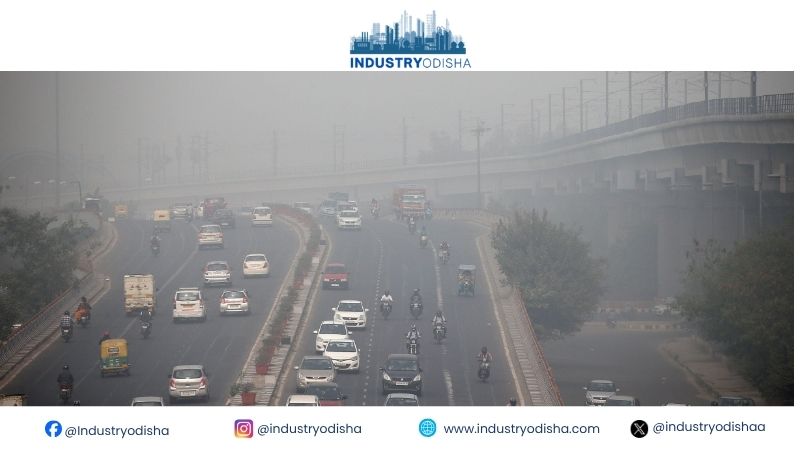
Industry Odisha Bureau, Oct 25: Road dust pollutes Indian cities long after winter smog lifts. Road dust loads far exceed those in global cities. Fixing it needs source control and reliable data.
Winter smog dominates India’s air pollution debate, but road dust never leaves. A 2024 study by IIT Delhi and IIT Kanpur researchers found striking dust loads. Silt on Indian roads was 25 to 30 times higher than in developed countries. Silt load measures dust settled on road surfaces, not airborne particle levels. Yet moving vehicles keep lifting that dust back into the air all year.
The study sampled 259 locations across 32 cities. It estimated road dust contributes 30–60% of PM2.5 and PM10 in metropolitan regions. It also linked about 10,000 deaths a year to road-dust-related PM2.5. A 2026 WRI India working paper offers a city-level view. It recorded peak silt loads of 19.7 grams per square metre in Ahmedabad. Mumbai reached 6.8 grams and Indore 4.9 grams on certain stretches. Secondary data cited by WRI put Milan’s range at 0.006–0.066 grams.
PM10 particles are under 10 microns wide; PM2.5 particles are finer still. Long exposure is associated with asthma and chronic obstructive pulmonary disease. Children, older people and outdoor workers face particular risk. Overall air pollution is linked to over two million Indian deaths. That estimate comes from the State of Global Air Report 2025. Illness also carries costs through medical bills and lost workdays.
Many Indian roads are not paved edge to edge, leaving soil-covered shoulders exposed. Construction debris, uncovered trucks and excavated soil add fresh dust daily. WRI’s Sree Kumar Kumaraswamy said resuspended dust mixes with tyre and brake wear. That mixing can form more toxic compounds, he said, though toxicity data remain scarce. Cleaning brings only temporary relief. In WRI’s three study cities, dust returned to pre-cleaning levels within four to eight days.
Since 2019, the National Clean Air Programme has allocated nearly ₹16,500 crore across 130 cities. More than 60% of the relevant funds go to dust management, according to WRI. Between FY18 and FY25, 64 cities cut annual PM10 by at least 20%. That figure came from the environment ministry’s reply in Parliament last December. However, only 22 have met the national PM10 standard of 60 micrograms per cubic metre.
WRI noted that cities often report kilometres swept or machines deployed. Such figures show activity, not how much pollution actually fell. Dhirendra Singh of Airshed Planning Professionals said some vacuum sweepers release fine particles.
PM10 can vary sharply from street to street, unlike more widely dispersed PM2.5. Ronak Sutaria of Respirer Living Sciences favours location-specific monitoring before heavy spending. He suggests GPS-tracked sweepers, biodegradable dust suppressants and roadside vegetation in dust corridors. Mumbai mandated real-time monitoring at more than 3,000 construction sites last May. Developers receive alerts when pollution crosses set thresholds. Respirer reports a 10–15% drop in pollution levels, a figure yet to be independently verified.
Lasting gains will depend on stopping dust at its source. That means fuller paving, contained construction sites and proper debris handling. Spending must be judged by cleaner air, not machines deployed.
