



Industry Odisha Bureau, Jul 31: Geopolitical shocks rarely translate smoothly into consumer behaviour. Yet this year’s Middle East conflict has achieved something energy policymakers have pursued for decades: a fundamental reset in how millions of people think about fuel costs and transportation choices.
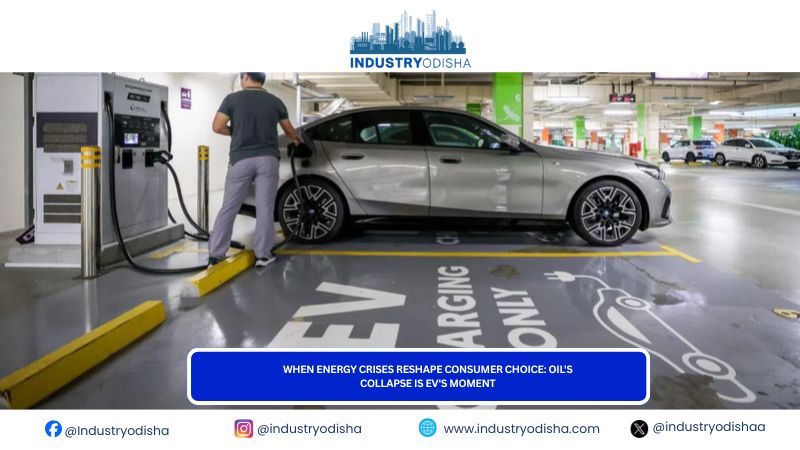
Electric vehicle sales surged 35 percent in the second quarter compared with the opening three months of 2026, reaching milestone penetration levels across fifty nations. The acceleration follows a first-quarter collapse in EV demand that had prompted industry observers to question whether the global automotive transition might be stalling. Instead, the shift reveals how quickly purchasing calculus changes when energy security becomes tangible rather than abstract.
The catalyst was crude’s violent repricing. As Iranian actions effectively closed the Strait of Hormuz a chokepoint through which one-fifth of global petroleum flows oil jumped from roughly $60 per barrel in January to nearly double that within months. For economies dependent on energy imports, the implications were immediate and unsettling: transportation, which consumes approximately half of all global crude, suddenly represented a visible economic vulnerability.
This recognition triggered government action across oil-importing regions. Southeast Asian nations, particularly exposed to supply disruption, rapidly deployed temporary tax incentives targeting electric vehicle purchases. Latin America and Europe followed suit with more sustained subsidy frameworks, effectively betting that accelerating automotive electrification serves dual purposes: insulating consumers and businesses from price volatility while reducing dependency on volatile international markets.
The International Energy Agency projects electric vehicles will account for roughly 29 percent of global new car sales throughout 2026, representing 10 percent growth even as the broader automotive market contracts. Europe emerged as the strongest performer during the first half of the year, with EV adoption climbing beyond 30 percent a trajectory that reflects both robust government incentives and consumer recognition that electricity pricing offers more stability than petrol markets.
China’s weakness early in the year masked this broader momentum. Subsidy reductions combined with economic constraints depressed what remains the world’s largest EV market, temporarily obscuring acceleration elsewhere. The United States similarly decelerated as reduced federal support dampened demand, highlighting how government policy frameworks remain central to adoption trajectories.
What distinguishes this quarter’s acceleration from previous cycles is its origin. Rather than environmental sentiment or technology enthusiasm driving purchases, consumers increasingly view electrification through an energy security lens a framing that renders EV adoption less vulnerable to boom-bust sentiment cycles and more rooted in durable economic self-interest. This recalibration may prove more consequential for the automotive industry’s long-term trajectory than any marketing campaign.
