



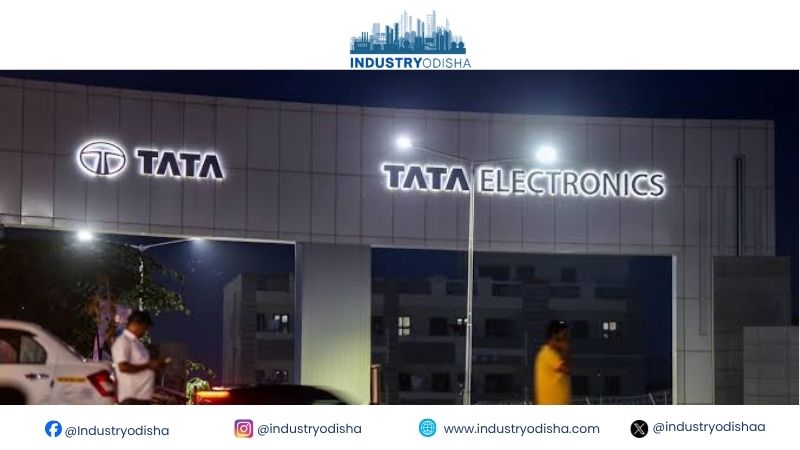
Industry Odisha Bureau, Oct 05: Tata Electronics’ Assam chip assembly plant is expected to begin operations by December. At least nine non-Chinese suppliers are already on board. The aim is a resilient semiconductor supply chain.
Building a chip plant takes money, land and policy support. Keeping it running takes something harder: a dependable vendor network. Semiconductor assembly relies on steady access to equipment, materials, spares and servicing. Any break in that chain can stall production.
Tata Electronics is tackling this risk at its Assam plant. It has spread its supplier base across several countries.
Redundancy, not retreat
At least nine non-Chinese suppliers have joined the project, Mint reported. They include Singapore’s ASMPT, the Netherlands’ Nexperia, Japan’s Fujifilm and Malaysia’s Kelington.
The goal is to keep India’s flagship semiconductor venture resilient. It must withstand potential trade blockades, retaliatory mineral curbs and wider geopolitical shocks.
Yet the strategy is not about shutting China out. One executive said the aim was a diversified set of alternatives. Chinese partners are not being left out, the executive added. Another executive said the move should not be read as anti-China policy.
Who supplies what
Each vendor covers a different link in the chain. ASMPT will provide training, software servicing, spares, wirebond circuitry and integrated-circuit assembly. Nexperia will bring European supply-chain vendors to India. It will also support chip testing and automotive product manufacturing. Fujifilm aims to localise the production and sourcing of semiconductor raw materials. Kelington will supply machinery and infrastructure.
Why concentration matters
Assembly supply chains typically lean heavily on China. One executive estimated that 55–60% of OSAT suppliers are usually China-based. The executive did not disclose Tata’s own exposure.
Technology export curbs by several countries, including China, have sharpened the risk. The West Asia war has also caused outages of critical gases. One executive cited unpredictable tariffs and geopolitical bargaining as further concerns. A publicly subsidised plant should not be halted by sudden supply cuts, he argued.
Assam handles the back end
The Jagiroad unit is an outsourced semiconductor assembly and test (OSAT) facility. A fabrication plant makes silicon wafers carrying numerous transistors. An OSAT cuts those wafers into chips, packages them and tests them.
Tata Semiconductor Assembly and Test (TSAT) runs the plant, announced on 29 February 2024. Its initial net budget was ₹27,000 crore. It will be India’s third OSAT facility.
Assam chief secretary Ravi Kota said on 21 September that operations should begin by December. The 592-acre facility is described as already running at one-fourth of capacity. At full scale, it is slated to make 48 million chips a day.
Dholera completes the picture
Tata’s Dholera project in Gujarat is a separate chip fabrication plant. It carries a net project cost of ₹91,000 crore. State and central subsidies cover 70% of net capital for both projects. That leaves the Tata Group investing ₹35,400 crore across the two.
TSAT has yet to earn significant revenue. It has posted ₹575.54 crore in losses over three fiscal years. Such early losses are common in capital-intensive sectors.
Beyond the factory gate
Tata Electronics, owned by Tata Sons, leads the group’s high-tech manufacturing push. Its early rivals include Micron, Kaynes Technology, CG Power and an HCL-Foxconn joint venture.
Harshit Kapadia of Elara Capital expects the OSAT to start before Tata’s fab. Electronics assembly will drive volumes for now, he said. Semiconductors could later lift overall margins.
Ashok Chandak, president of the India Electronics and Semiconductor Association, sees a wider role. Both Tata projects could help India climb the semiconductor value chain, he said. They could also seed a domestic supply chain for future plants.
Resilience before scale
For Tata, starting production is only the first test. Keeping lines running through global shocks is the harder one. Its Assam vendor network is therefore more than a procurement exercise. It shows how India’s chip ambitions now hinge on supply-chain depth.
