



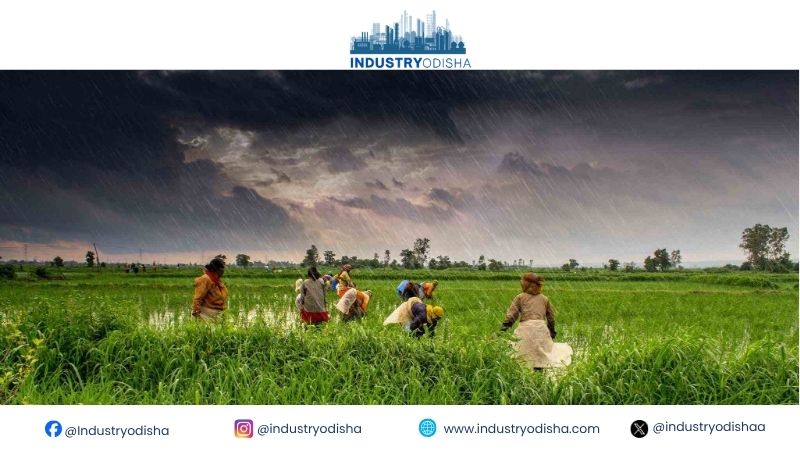
Industry Odisha Bureau, Oct 02: India’s Southwest monsoon delivered just 87% of the long-period average. Kharif sowing has slipped and reservoirs are running low. ICRA warns the strain could spill into the rabi season.
The monsoon season has ended, but its economic effects are still unfolding. India’s weakest monsoon since 2015 left fields short of rain and reservoirs short of water. Rainfall reached 87% of the long-period average (LPA) between June and September. ICRA’s monsoon assessment links the shortfall to El Nino conditions.
Uneven in Time and Place
Timing mattered as much as the total. June delivered just 60% of the LPA, before July rebounded to 103%. August slipped to 84% and September recovered to 93%.
The East and Northeast (74%) and the South Peninsula (76%) were both deficient. Northwest India received 94%. Central India was the only major region with normal rainfall, at 97%.
Kharif Shows the First Strain
Kharif acreage stood at 110.7 million hectares by end-September. That is 1.2% below last year, though broadly in line with historical averages. Rice fell 3.6% and cotton 1%, partly offset by gains in pulses and coarse cereals.
Some states fared worse. Karnataka’s acreage fell 14.8%, Andhra Pradesh’s 6.1%, Telangana’s 4.9% and Maharashtra’s 4%. Acreage, however, is not output. ICRA warns uneven rainfall could hurt yields even where sowing looks normal.
Reservoirs Carry the Risk Into Rabi
The bigger risk now sits in India’s reservoirs. Stored monsoon water irrigates rabi crops long after the rains end. Storage stood at 71% of full reservoir level on September 24. That compares with 90% a year earlier and a historical average of about 80%.
Southern reservoirs are 36 percentage points below last year and 24 below the historical average. Northern storage trails last year by 29 points and the historical average by 17. Weaker buffers could affect irrigation-intensive rabi crops such as rice and wheat.
Geography Will Shape the Outcome
Southern states account for about 98% of India’s rabi rice acreage. They also hold roughly 33% of coarse cereal acreage. Punjab and Rajasthan together cover about 31% of wheat acreage.
Uttar Pradesh offers a counterweight. It accounts for about 28% of wheat acreage and received 108% of LPA rainfall. Its storage sat 14 percentage points above the historical average.
From Fields to the Rural Economy
ICRA has cut its FY27 farm growth forecast to about 1%, from 1.3% earlier. The estimate covers agriculture, forestry and fishing GVA, which grew 3.3% in FY26. ICRA expects less monsoon-dependent livestock, forestry and fishing to cushion weaker crops.
The agency cautions weaker farm incomes could dampen rural demand in FY27’s second half. Rural sentiment fell sharply in the RBI’s July survey, though spending intentions held up. Rural unemployment eased to 4.1% in August from 4.5% in July. Yet nominal rural wage growth hit a 59-month low of 3.3% in July. Real rural wages contracted 1.6% year-on-year.
ICRA also expects rural inflation pressures to build in the third quarter of FY27. It cites higher food prices, West Asia-related costs and a low base.
Grain Stocks Offer a Buffer
Government granaries provide some cushion. Rice stocks were 39.1 million tonnes on September 1, 5.8% higher and well above norms. Wheat stocks stood at 48 million tonnes, up 44.1% and about 75% above norms. Still, ICRA says wheat output and prices will depend on rabi sowing and reservoirs.
Fertiliser Adds Fiscal Pressure
ICRA expects the fertiliser subsidy to overshoot its FY27 budget estimate of Rs 1.7 trillion. The gap could reach about Rs 900 billion, on costlier raw materials and West Asia tensions.
Water Becomes the Next Test
The weakest monsoon since 2015 is no longer just a rainfall story. Its next test lies in reservoirs, irrigation and rabi planting. ICRA sees the greatest risks in southern India and parts of the north.
