



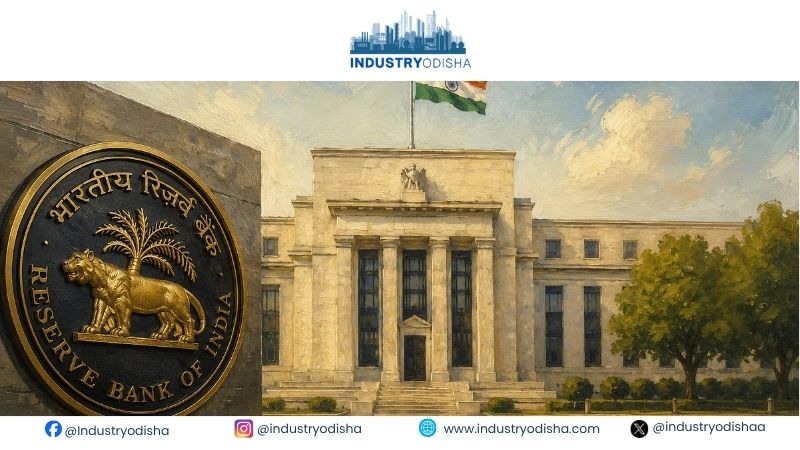
Industry Odisha Bureau, Oct 07: Nine of 10 economists expect a 25-basis-point hike on 7 October. Mounting inflation risks and tighter global rates drive the shift. Strong growth gives the central bank room to act.
Not long ago, economists expected India’s next rate hike in December or later. That timetable has moved sharply forward. Higher oil prices, a weak monsoon and tighter global money have changed the calculus. The Reserve Bank of India’s Monetary Policy Committee announces its decision on 7 October. A hike would be the first since February 2023.
A near-consensus call
Nine of 10 economists surveyed by Mint expect a 25-basis-point increase. That would lift the repo rate to 5.50%. All expect the MPC to keep its neutral stance. A neutral stance lets the RBI respond to data without committing to a long cycle.
Inflation risks mount
Inflation is the clearest driver. Consumer prices rose 4.8% in August, a 22-month high. That sits above the RBI’s 4% midpoint target. Economists see pressure spreading beyond a handful of food items. A below-normal monsoon threatens food prices. Rising commodity costs and a weaker rupee add imported inflation.
The RBI projected FY27 CPI inflation at 5% in August. Several economists expect that forecast to rise. Barclays forecasts 4.8%, with upside risk if crude stays above $100 a barrel. IDFC FIRST Bank’s Gaura Sengupta expects 5.2%. Sameer Narang, chief economist at ICICI Bank, says the global environment has “completely changed”.
Global money tightens
External conditions have shifted too. The US Federal Reserve raised rates at its September meeting. US Treasury yields remain elevated. Goldman Sachs expects further Fed tightening and flags Middle East risks to crude. The firm says this strengthens the case for earlier RBI action.
Hikes brought forward
Barclays previously expected 25-basis-point hikes in December and February 2027. It now sees them in October and December. Goldman Sachs expects the same timing. Most economists expect a shallow cycle of 50–75 basis points. That tightening may run through December or February 2027.
BofA Global Research sits at the hawkish edge. It raised its cumulative forecast from 50 to 100 basis points. The last cycle, from May 2022 to February 2023, added 250 basis points.
Growth leaves room
Strong growth eases the trade-off. GDP grew 7.8% in April–June, 80 basis points above the RBI’s forecast. The RBI currently projects FY27 growth at 6.7%. Economists expect an upward revision. Barclays now forecasts 7.1%, while Sengupta sees around 7.5%. Firm growth lets policymakers focus more on price stability.
The lone dissent
Bank of Baroda’s Madan Sabnavis expects no change in October. He warns a hike before the festive season could weigh on consumption. He would rather wait for September and October inflation data. A surprise pause, he argues, could also temper bond yields. Still, he expects 50–75 basis points of hikes over the cycle. His dispute is about timing, not direction.
Draining surplus cash
Liquidity is another lever. India drew $143.6 billion between 8 June and 31 August. Those flows came through FCNR deposits, external commercial borrowings and offshore foreign currency loans. They left the banking system with excess funds. Economists expect absorption through variable rate reverse repos, open market bond sales and swaps.
A narrower path
The RBI now faces firmer growth alongside mounting inflation risk. Oil and global tightening have narrowed its options. An October hike would mark earlier action, not necessarily aggressive tightening. The neutral stance would keep that flexibility intact.
