



Industry Odisha Bureau, Sep 06: Researchers found peptides remain stable in concentrated sulphuric acid. The acid was 98% concentrated in the study. These peptides also folded into complex structures. This challenges assumptions about hostile chemical environments. Peptides are biological macromolecules essential to life. The finding matters for the search for life beyond Earth.
Peptides are short chains of amino acids. They form the basic building blocks of proteins. Strong acids typically break peptides down through hydrolysis. Hydrolysis requires water molecules to break chemical bonds. Concentrated sulphuric acid contains almost no water. That absence prevents the usual hydrolysis reaction from occurring. This explains why the peptides remained structurally intact.
The peptides stayed stable for several weeks. Researchers observed this stability at room temperature. The result does not imply indefinite chemical survival. Chemical stability alone does not indicate biological activity.
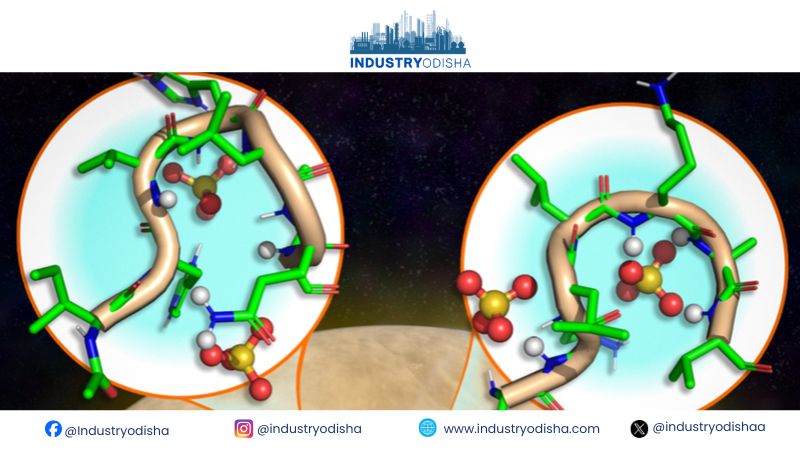
Scientists used nuclear magnetic resonance spectroscopy to study the molecules. This technique revealed a specific folded structure. The peptides formed what is called an omega loop. Sulphuric acid molecules acted as a structural scaffold. This scaffolding helped maintain the peptide’s folded shape. Molecular structure is critical for potential biological function.
This folding differs from typical behavior in water. Proteins in water commonly form helices or sheets. In sulphuric acid, omega loops appeared instead. The comparison highlights how environment shapes molecular structure. Omega loops are not proof of biological function.
The discovery extends earlier chemical-stability research. Scientists had already shown amino acids remain stable there. Nucleic-acid bases showed similar stability in past studies. Peptides now join this list as macromolecules. This matters more since peptides serve vital biological roles.
The study appeared in a peer-reviewed journal. Proceedings of the National Academy of Sciences published it. The publication date was September 4, 2026.
Venus adds particular relevance to this research. The planet’s clouds contain concentrated sulphuric acid. Scientists previously assumed such conditions barred complex chemistry. This assumption stemmed from acid’s typical destructive chemical behavior. The new findings challenge that long-held assumption directly.
This does not mean Venus hosts life. No peptides have been detected on Venus. The study does not prove Venus is habitable. Instead, it broadens ideas about chemical possibility. Extreme acidity may not automatically exclude complex molecules.
For astrobiology, the implications remain carefully bounded. Researchers may now reconsider criteria for hostile environments. Environments once dismissed could still host complex chemistry. This does not equate to evidence of extraterrestrial organisms. The finding invites broader questions rather than definitive answers. Scientists emphasize this reshapes assumptions, not conclusions about life.
