



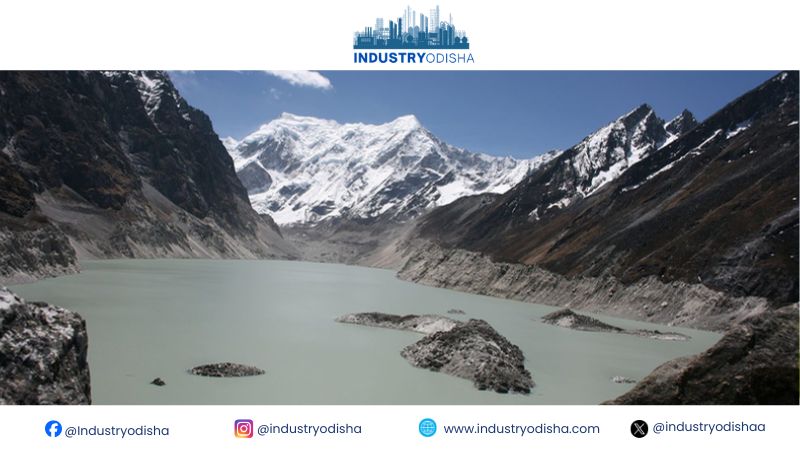
Industry Odisha Bureau, Sep 02: In the aftermath of the recent cataclysm in shape of ferocious flash floods on August 26 that have already devastated hundreds of lives as well as swept away and swallowed large scale human habitats in Nepal and adjoining Tibet in China, experts have reportedly warned that more glacial lake outbursts, that have already caused the catastrophe, are still looming large over the Himalayas risking yet again millions of lives in Nepal, Tibet and India.
Media reports, citing observations and warnings of experts, have already stated that, “The Himalayas are facing a significant risk of glacial lake outburst floods (GLOFs) due to the rapid retreat of glaciers and formation of new lakes. As glaciers melt, they can create new lakes that, if overfilled, can lead to catastrophic outbursts.”
In this context, the media reports have added that, “The International Centre for Integrated Mountain Development (ICIMD) and the United Nations Development Programme (UNDP) have identified 3,624 glacial lakes in the Koshi, Gandaki, and Karnali basins, with 47 classified as high-risk prone to overflow. The total number of dangerous lakes in the Hindu Kush Himalaya (HKH) region is estimated to exceed 200, with projections indicating that this number could triple by the end of the current 21st century. The risk of glacial lake collapses in the HKH region is also projected to reach three times the level of the 2020s by the end of the 21st century with an estimated 80% of HKH glaciers disappearing by 2100.”
Scientists have also reportedly highlighted that, “Effects of Climate Change and Global Warming are now beings vividly viewed following which the glaciers in the Himalayas have become unstable, started melting and could trigger more flash floods ferociously in near future. Since the Himalayas are warming faster than other areas, the fate of Nepal, Tibet and India in jeopardy.”
As per latest media reports, “China’s Ministry of Water Resources in its fresh warning issued on August 31 has underlined that the glaciers surrounding the Cuojian River in Nepal, where the glacier collapse occurred on August 26 and wrecked the unprecedented havoc, have become unstable and could cause ferociously more flash floods. The Synthetic Aperture Radar (SAR) imagery has shown that the water in the impact crater on Nepal’s Cuojian River has gone down significantly, shrinking to about 83,000 sq mtrs from 108,000 sq mts on Sunday (August 30) morning. However, more landslides could create another blockade, threatening the formation of another barrier lake.”
