



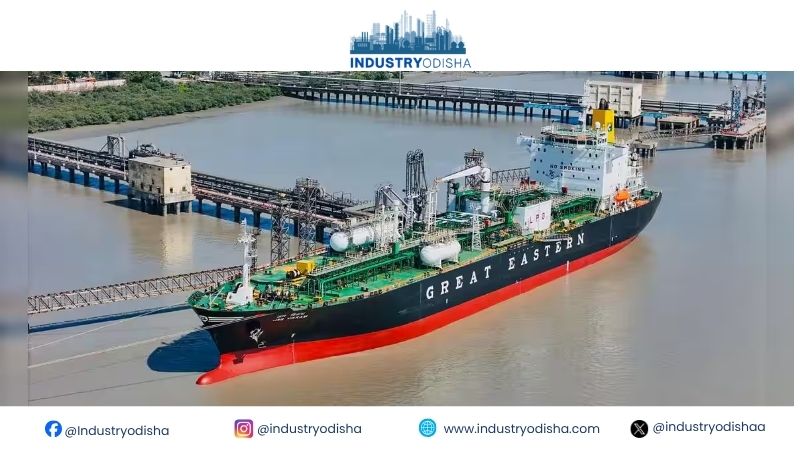
Industry Odisha Bureau, Oct 21: The planned Tuna Tekra terminal is designed for 18.33 million tonnes of annual cargo. Under a public-private partnership, Essar will invest ₹1,552.57 crore and the port authority ₹723.49 crore.
Deendayal Port Authority has approved Essar Ports Limited to develop a multipurpose cargo terminal. The facility will be built at Tuna Tekra in Kandla, Gujarat. Its estimated cost is ₹2,276.06 crore. Approval is only the first step before construction, commissioning and commercial operations.
Essar will invest ₹1,552.57 crore, or roughly 68.2% of the total. The port authority will contribute ₹723.49 crore, close to 31.8%. The project follows a Build, Operate and Transfer (BOT) model. It has been awarded on a public-private partnership basis.
The terminal is planned to handle 18.33 million tonnes of cargo a year. It will have four berths, each 300 metres long. Together, they give a combined berth length of 1,200 metres. It is designed for Capesize vessels of up to 170,000 deadweight tonnes. Its draught capability extends up to 18 metres.
Each figure measures something different. Annual capacity measures a terminal’s yearly cargo throughput potential. Deadweight tonnage is the weight a single ship can carry. Draught is the depth a loaded vessel sits below the waterline. Capesize ships are among the largest dry-bulk carriers.
Under the BOT model, a private concessionaire builds and operates an asset. It later hands the asset back under agreed contractual terms. Concession length and revenue terms were not disclosed. Such structures let public authorities draw on private capital and operating expertise.
The port authority will provide common-user infrastructure. This includes dredging the access channel, berth pockets and turning circles. It will also build a common approach road. Dredging deepens waters so heavier ships can reach berths safely. Turning circles give large vessels room to manoeuvre.
Essar expects the terminal to ease pressure on Kandla’s existing dry-cargo berths. Added capacity could reduce congestion and improve operational flexibility. The company also expects larger vessels to make shipping more efficient. These remain projected benefits rather than measured outcomes.
Essar also expects stronger multimodal connectivity across sea, road and inland transport. Efficient links between ports and industrial centres matter for import and export cargo. Extra berths deliver most value when cargo can move swiftly inland. Road access and onward transport capacity will shape the terminal’s usefulness.
Essar Ports currently has about 60 million tonnes per annum (MTPA) of operational capacity. Its assets span Gujarat, Indonesia and the United Kingdom. In India, it has developed and operated 168 MTPA of port capacity. Of that, 148 MTPA has since been monetised. Tuna Tekra’s capacity is not yet included.
Ashish Rajgarhia, Essar Ports’ chief executive, described the project as “a defining moment”. He said it begins a new journey to rebuild and expand the ports business. He added that it would underpin Essar’s next phase of growth. These are management expectations, not established outcomes.
The terminal will follow the Green Port Policy, though specific measures were not detailed. If built, it would add to private investment in Indian port capacity. Its eventual value will depend on execution, dredging, cargo demand and competition from rival ports. Planned capacity does not guarantee cargo volumes.
