



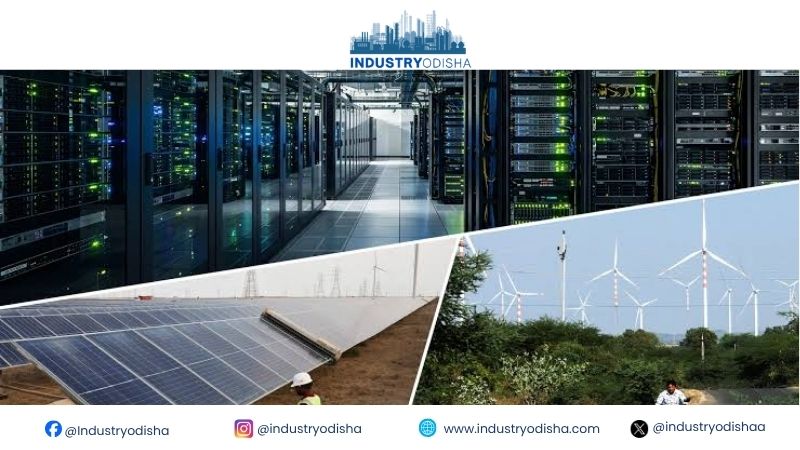
Industry Odisha Bureau, Oct 09: Google, Amazon, Meta and Apple are emerging as major clean power buyers in India. Renewable capacity for data centres could double to 32.4 GW by 2030. Developers gain, but steady supply remains a challenge.
Big Tech’s hunger for electricity is reshaping India’s renewable energy market. Google, Amazon, Meta and Apple have become major corporate buyers of clean power. Their data centre expansion is driving the surge in demand.
Anand Rathi Research estimates renewable capacity for data centres could reach 32.4 GW by 2030. That would be double the 16.1 GW estimated for this year.
Why AI needs power
Artificial intelligence and cloud computing run on power-hungry servers. Data-centre IT load could double from 2.7 GW this year to 5.4 GW by 2030. IT load is the power servers actually draw. Renewable capacity is larger because solar and wind do not generate constantly.
The report says about 4 GW of extra round-the-clock clean power may be needed.
Long contracts, steady revenue
Hyperscalers no longer rely solely on state distribution companies for power. They are signing power purchase agreements, or PPAs, lasting 15 to 20 years. Such contracts give developers predictable revenue. That visibility helps developers finance and build new projects. Buyers, in turn, gain more predictable long-term power costs.
Who is buying
Meta has contracted nearly 1 GW of new renewable energy in India. This includes 837 MW of solar and wind projects with Clean Max Enviro Energy Solutions. Another 88 MW comes from Fourth Partner Energy.
Meta has also partnered Reliance Industries on a 168 MW AI-enabled data centre. The Jamnagar, Gujarat facility is not a power purchase deal.
Amazon has signed 199 MW of wind PPAs with CleanMax and BluPine Energy. Its Indian renewable portfolio spans 50 wind and solar projects.
Google has backed a 150 MW solar project in Rajasthan through a long-term deal. It had earlier supported 186 MW of wind and solar capacity in India.
Developers gain
Mumbai-based CleanMax has emerged as a major beneficiary. Data and AI make up about 42% of its contracted renewable power sales capacity. It has also secured over 35% of hyperscaler deals signed in India, the research says.
Group-captive and open-access structures let large users buy power directly from developers. These can lower electricity costs compared with conventional grid supply.
Virtual PPAs and energy attribute purchase agreements widen the options further. They let companies claim renewable attributes without physical delivery to their facilities. Such contracts help meet carbon targets, but do not guarantee round-the-clock clean supply.
The reliability test
Data centres need power every hour of every day. Solar and wind output, however, rises and falls with weather and daylight. Battery storage, hybrid projects and stronger grids could help fill those gaps.
Not every projected gigawatt will necessarily turn into a built project. Still, long-term Big Tech demand gives developers a firm base to expand. The next test is delivering reliable clean power at competitive prices.
