



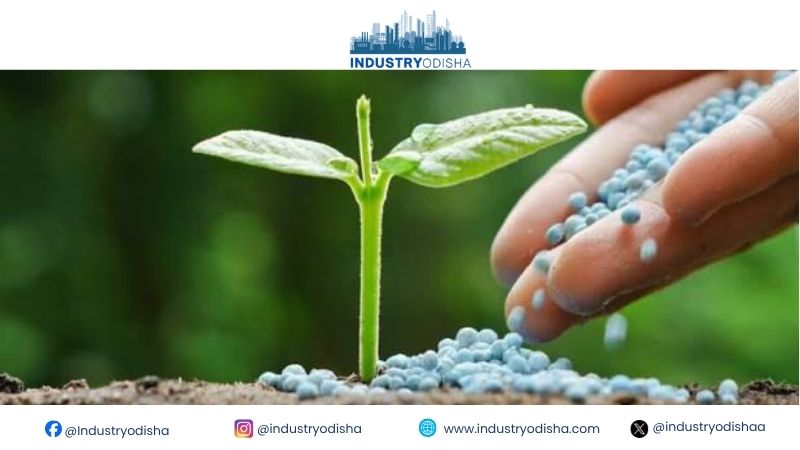
Industry Odisha Bureau, Oct 11: Use of water-soluble, liquid and fortified nutrients is rising amid soil-health concerns. Conventional fertilisers remain vital for food security. Policy support under PM-PRANAM aims to widen adoption.
India’s fertiliser mix is slowly broadening beyond conventional mineral products. Demand for water-soluble, liquid and fortified nutrients has risen sharply in recent years. Yet conventional fertilisers remain central to the country’s food security. Mineral fertilisers are estimated to drive 40–50% of crop yield gains. Soil pressures are now pushing the sector to diversify. Organic carbon is declining, nutrients are imbalanced, and fertiliser efficiency remains low.
Suresh Kumar Chaudhari, Director General of The Fertiliser Association of India, sees an opening. He argues India’s next fertiliser revolution lies in combining conventional and new-age products.
Water-soluble and liquid products grow
Water-soluble fertilisers show both the growth and its limits. Their consumption rose about 5.7 times between 2011–12 and 2024–25. Micro-irrigation coverage grew from 6.1 million hectares in 2012 to 16.7 million in 2024. The two trends moved together, though one did not necessarily cause the other.
Even so, water-soluble products make up just 0.6% of total fertiliser use. Precision farming and drip irrigation could widen that share. Liquid fertiliser use, meanwhile, climbed from 422,156 litres in 2022–23 to 762,450 litres in 2024–25. That is a rise of nearly 81% over the period.
Filling micronutrient gaps
Micronutrient depletion is another growing concern. Continuous cropping removes nutrients that are often not fully replaced. India used about 333,500 tonnes of micronutrients in 2024–25. Zinc sulphate made up 63.5% of that total. Ferrous sulphate, boron, manganese and copper products followed.
Fortified fertilisers aim to deliver such nutrients more precisely. In 2025–26, about 52.7% of single super phosphate (SSP) sold was fortified. Under the nutrient-based subsidy framework, zinc fortification earns an extra ₹500 per tonne. Boron fortification receives an additional ₹300 per tonne. Subsidies encourage adoption but do not guarantee better yields.
Rebuilding soil biology
Soil organic carbon in India is often below 0.5%. Organic matter and soil biology therefore need closer attention, Chaudhari argues. Organic fertilisers add organic material alongside nutrients. Bio-fertilisers work through beneficial organisms instead. These include nitrogen fixers, phosphorus solubilisers, potassium mobilisers and zinc solubilisers. Mycorrhizal products form another category. Such inputs may improve nutrient availability and use efficiency.
Bio-stimulants may aid root growth, nutrient uptake and tolerance to drought or salinity. None is presented as a full substitute for mineral fertilisers.
Nano promise, with caveats
Nano urea and nano DAP are newer additions to the mix. They are designed to deliver nutrients in a more targeted way. Their potential lies in better nutrient-use efficiency. They could also cut the quantity of conventional fertiliser required. Lighter volumes may ease logistics and possibly reduce environmental impact. These benefits remain potential rather than universally demonstrated.
Policy and coordination
The central government’s PM-PRANAM initiative offers a policy framework for alternative nutrients. It also aims to promote more sustainable farming practices. Chaudhari wants states to give fertiliser companies a level playing field under the scheme. That is an industry recommendation, not an announced government decision.
Wider adoption will depend on several players working together. These include governments, fertiliser makers, scientists, extension agencies and farmers. The goal is integrated nutrient management that raises productivity while protecting soil.
