



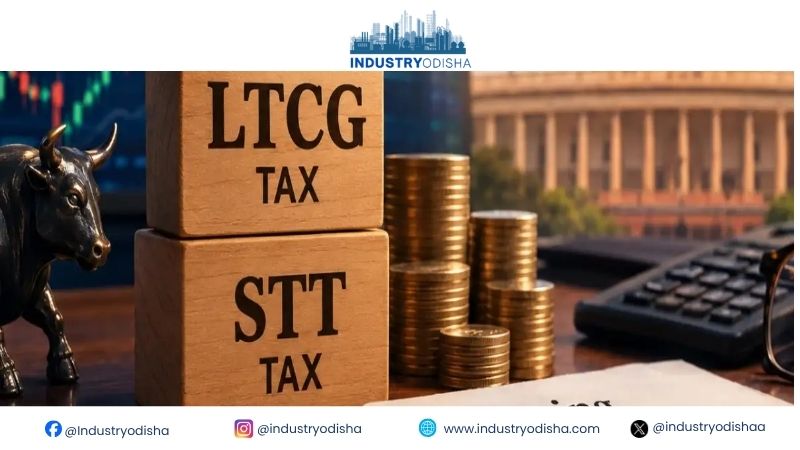
Industry odisha Bureau, Oct 27: The government has begun reviewing how India taxes capital market investments. Officials are seeking investor and expert views on LTCG and securities transaction tax. The review comes as foreign portfolio investors keep pulling money out of Indian stocks. The Economic Times reported the consultations, citing people familiar with the matter.
The exercise remains at a preliminary stage. No tax change has been proposed or announced by the finance ministry. Market participants, tax practitioners and investors are being asked for concerns and suggestions.
Finance Minister Nirmala Sitharaman acknowledged the debate at a Delhi event on October 13. She said budget preparations had already begun. She declined to say what she would or would not consider. She added that investors in India and overseas had raised the issue with her. Stocks rose after her remarks.
The pressure from foreign selling is real. FPIs withdrew ₹52,100 crore from Indian equities in October up to mid-month. That lifted 2026 outflows to ₹3.12 lakh crore, nearly double 2025’s total. ET says Indian stocks have lost $924 billion in value since their September 2024 peak.
Taxes are only one part of this story. Analysts link the selling to costly crude, high US bond yields and a firm dollar. Strong returns from AI-driven stocks overseas are also drawing global capital away. The government itself has called the outflows part of a wider emerging-market trend. Valuations and corporate earnings also shape foreign investor decisions.
Still, the tax burden has become a recurring complaint. India taxes long-term gains on listed shares held over a year at 12.5%. With surcharge and cess, ET reports the effective rate nears 15%. The rate was raised from 10% in the July 2024 budget. On top of that, each delivery trade attracts STT of 0.1% on buyer and seller. Buyers also pay stamp duty of 0.015%.
Market participants call this double taxation. The two levies, however, work differently. STT is charged on the value of every trade, profit or loss. LTCG applies only to the gain made when shares are sold. What irks investors is that both fall on the same transaction.
India introduced STT in 2004 as a replacement for LTCG on listed shares. LTCG on equities returned in 2018, but STT stayed. Pratik Jain of Price Waterhouse & Co. LLP noted STT was meant as a substitute.
Revenue is the government’s biggest constraint. LTCG collections reached ₹1.29 lakh crore in FY25. That was nearly double the ₹72,249 crore collected a year earlier. STT brought in ₹57,522 crore in FY26. Between April 1 and October 14 this year, STT receipts rose 52%. They reached ₹46,840 crore over that partial period.
People familiar with the review say any change must weigh this revenue. Fertiliser subsidies are climbing because of the West Asia conflict. Large social sector schemes also need steady funding. Some opposition voices warn that scrapping these levies would shrink taxes shared with states.
Expert views converge on one point: India must stay competitive. Sudhir Kapadia, senior advisor at KPMG, compared India with major rival markets. He cited the US, UK, Singapore, Hong Kong, South Korea and Taiwan. None of them, he said, taxes non-residents on listed securities gains.
That comparison needs context. Several of those markets levy their own transaction charges. Hong Kong charges 0.1% stamp duty on both buyer and seller. Taiwan imposes a 0.3% securities transaction tax on sellers. Treaty terms and residency rules also shape what foreign investors actually pay.
Kapadia proposed exempting FPIs from capital gains tax while raising STT. He argued this could keep revenue neutral and remove friction for foreign investors. He also said it would discourage high-frequency trading by some FPIs. Whether the swap is truly revenue neutral remains untested. A higher STT would also raise costs for domestic traders.
Sameer Gupta, EY India tax leader, called for a holistic review of FPI taxation. He noted that key global markets do not levy capital gains tax on FPIs. Jain suggested a zero LTCG rate for longer holding periods. He also proposed allowing STT to be set off against capital gains tax. Either step, he said, would reward patient capital.
Tax certainty is a separate worry. On January 15, the Supreme Court denied Tiger Global India–Mauritius treaty benefits. The case concerned its roughly $1.6 billion Flipkart stake sale to Walmart in 2018. The ruling overturned an August 2024 Delhi High Court verdict favouring Tiger Global. The court treated the structure as an impermissible tax avoidance arrangement. Gupta said treaty benefits must be applied clearly and consistently. He stressed this was vital for grandfathered investments made under older treaty terms.
The government has already eased taxes on one asset class. In June, it scrapped LTCG and interest withholding tax on FPI-held government bonds, ET reported. That move raised hopes of similar relief for equities.
Budget 2027, usually presented on February 1, is the next decision point. Lower levies could improve India’s appeal to global investors. Yet they would cost revenue at a time of rising spending needs. Taxes alone are unlikely to reverse flows driven by global rates and currencies. For now, the review signals openness, not commitment.
