



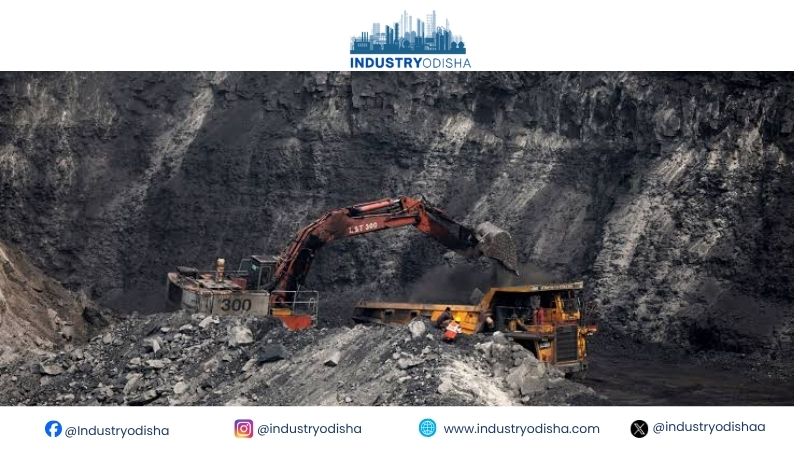
Industry Odisha Bureau, Oct 27: India has auctioned 733 mineral blocks, but only 125 were producing by August 2026. That is roughly 17% of the blocks states have put under the hammer. The gap shows India’s mining sector remains underdeveloped despite years of reform. It also exposes a strategic risk as nations race to secure critical minerals.
The figures come from sectoral reviews by the coal and mines ministries, ET reported. The reviews were shared with states before the sixth national conference of chief secretaries. They describe high import dependence and severe execution bottlenecks on the ground. The Centre wants states to treat the problem as a mission-mode priority.
The remaining 608 blocks are not a single story. Many are stuck at various stages of clearance, according to the reviews. But the auction pipeline has also grown rapidly in recent years. India auctioned a record 212 blocks in FY26 alone. Of 200 blocks auctioned that year, 77 were composite licences needing exploration first. Financing, commercial viability and infrastructure also decide which mines move forward.
Still, the timelines are long. ET reports that award-to-production often exceeds seven years for major and critical minerals. The mines ministry said in May that 101 auctioned blocks had become operational since 2015. The two counts may differ in scope, but both show slow conversion.
Critical minerals sharpen the stakes. The reviews flag extreme supply-chain vulnerabilities from import reliance and immature deep-drilling technology. India produces more than 95 minerals, according to ET. Yet it depends heavily on imports for lithium, cobalt and rare earth products. The IEA estimates China handles about 90% of rare earth refining. Its share of lithium refining is around 70%, and cobalt refining exceeds 75%.
That concentration matters because mining is only the first step. A rare earth deposit is not the same as usable magnet material. Ore must be separated, refined and purified to exacting industrial standards. India’s domestic capacity for high-purity processing remains limited, the reviews note. Even successful mining would not end import dependence on its own.
The Centre has asked states to create a framework for extracting beach sand minerals. These include monazite, a key source of rare earth elements. Monazite also contains thorium, which brings it under atomic energy controls.
Geology adds another hurdle. Easily reached deposits near the surface are running out. Future finds lie deeper, beneath regolith, basalt or thick sediment. Reaching them needs advanced drilling and exploration technology. The reviews say such technology is not commercially proven in India. Importing it is costly, and investors remain wary of the risks.
On the ground, land acquisition is the biggest single obstacle. The reviews call it the main dependency on a project’s critical path. Land records are fragmented, and titles are often disputed. Compensation assessments are complex, and some communities resist handing over possession. Rehabilitation and resettlement add further steps.
Forest clearance creates its own delay. Projects on forest land must fund compensatory afforestation elsewhere. Many states lack pre-identified land banks for this, so forest proposals stall.
Fragmented state level regulation compounds the problem. The Centre points to many uncoordinated state cesses and overlapping levies. Projects need multiple approvals from different departments, often one after another. For minor minerals, concession rules vary widely between states. Single-window portals are missing, and district survey reports arrive late.
These challenges feed on each other. A disputed title delays land possession. That holds up forest clearance, which pushes back other approvals. Each delay raises financing costs and weakens a project’s commercial case.
Environmental concerns run through the entire debate. Illegal sand and stone mining has damaged riverbeds, the reviews note. It also drains royalty that should flow to state treasuries. States also lack standardised, GIS-enabled mineral inventories. ET reports this has led to unscientific quarry mapping and local environmental damage. Law and order problems periodically halt exploration and mineral dispatch too.
Not every delay is red tape. Environmental assessments, forest protection and community consultation serve legitimate purposes. Faster mining should not mean weaker safeguards. The real target is avoidable delay: duplicated approvals, poor records and slow coordination.
Logistics is the final link. The reviews cite gaps in first-mile connectivity, rail sidings and port links. Stockyards, high-capacity road corridors and simpler transit permits are also needed.
The money at stake is large. Mining contributes over ₹1.9 lakh crore a year to government exchequers, ET reports. About 90% of this goes directly to states. That gives states both the incentive and the power to speed things up.
The Centre’s prescription is a complete value chain approach. It links resources to revenue, auctions to operational mines, and waste to wealth. Proposed steps include faster discovery and more private exploration. Others cover deep-mining technology, critical mineral processing, and recycling and refining hubs. The plan also seeks state-level facilitation cells to speed clearances. Digitised land records, fewer overlapping levies and time-bound auctions are on the list. Digital tracking would target illegal mining. These remain proposals, not implemented reforms.
They build on existing efforts. India launched the National Critical Mineral Mission in January 2025. It carries a seven-year outlay of ₹34,300 crore, or about $3.7 billion. The ministry has auctioned 56 of 88 critical mineral blocks offered across seven tranches.
The stakes extend beyond mining revenue. Electric vehicles, renewable energy, electronics and defence all need secure mineral supply. India’s ambitions in these sectors depend on turning mineral rights into usable materials. Auctions have shown that investor interest exists. The harder test is execution, from the first clearance to the refinery gate. Until that gap narrows, much of India’s mineral wealth will remain on paper.
