



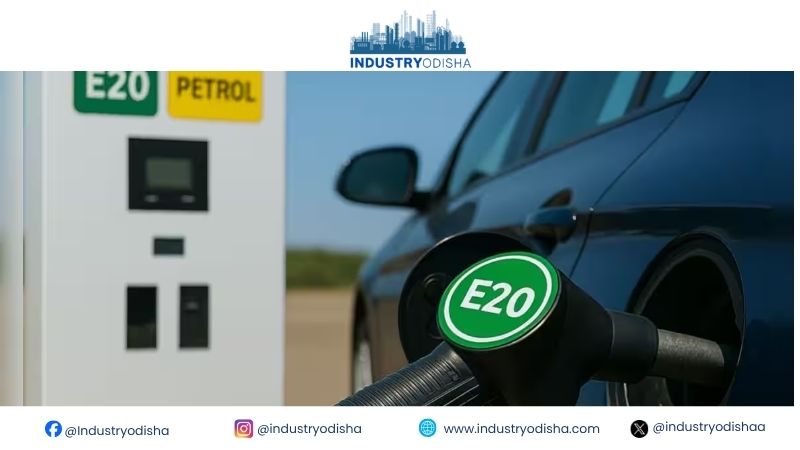
Industry Odisha Bureau, Oct 23: Automakers want the proposed BS VII fuel vapour limit eased to 2 grams per test. The draft sets 1.5 grams. The industry cites E20 petrol, though views differ on the science.
Indian automakers are likely to seek a looser cap on fuel vapour emissions. They want room under the proposed Bharat Stage VII, or BS VII, standards. The draft sets a limit of 1.5 grams per test. Industry body SIAM has proposed at least 2 grams, Mint reported, citing a draft submission.
Society of Indian Automobile Manufacturers (SIAM), argues rests on E20 petrol, which contains 20% ethanol. India’s base fuel blend is higher than in most major economies.
The government proposed the BS VII norms on 14 October. They would apply from 2029 in three phases. Cars, light trucks and heavy commercial vehicles would be covered. The draft also seeks closer emissions monitoring, including pollutants from tyre wear. The BS VI norms took effect in 2020.
Evaporative emissions are fuel vapours escaping from a vehicle, rather than exhaust gases. Under a 1.5-gram cap, a vehicle may release no more than that during testing.
The industry’s case centres on Reid Vapour Pressure, or RVP. RVP measures how easily a fuel evaporates. SIAM’s draft representation says E20’s RVP is higher than E10’s. It therefore calls for a 2-gram limit.
Fuel differences abroad are central to the argument. Europe’s Euro 7 norms use E10, or sometimes E5, as base fuel. The EU moves to Euro 7 from November 2026. The US also commonly uses E10, alongside flex-fuel blends such as E85 and E100.
Experts remain divided on the technical question. I.V. Rao of The Energy and Resources Institute said E20 would inevitably produce more vapour. He said volatility rises with the blend, so norms must reflect it.
C.K. Jain of the Grain Ethanol Manufacturers Association took a more nuanced view. He said E20 does not automatically have higher vapour pressure than E10. Fuel composition and vehicle vapour controls, he argued, shape actual emissions. Jain said testing should decide between the 2-gram and 1.5-gram limits.
Neither figure is final. The government’s limit remains a draft, and SIAM’s is only a proposal. SIAM, several automakers and relevant ministries did not respond to Mint’s queries. Mahindra & Mahindra declined to comment.
India made E20 the standard petrol blend in 2025. Some motorists have since reported lower mileage and engine problems. The government has acknowledged mileage may fall by 3–5%. It maintains that vehicles were extensively tested for the blend.
Officials defend the programme as good for farmers and energy security. India launched E85 petrol on 5 June, priced ₹20 a litre below E20. Higher blends such as E23 and E27 were also reportedly under consideration.
For automakers, a tighter limit could mean upgraded vapour-control systems. Regulators must balance cleaner air with what the fuel allows. Independent testing under Indian conditions may prove decisive.
