



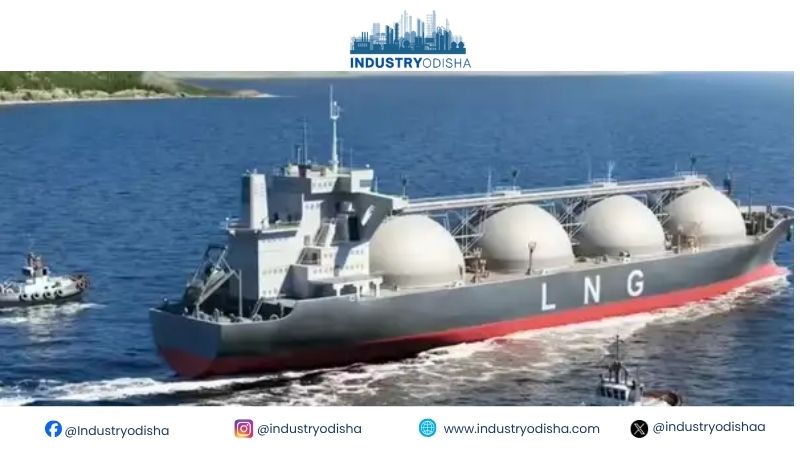
Industry Odisha Bureau, Oct 23: India’s LNG imports rose 9% in March–September as new suppliers stepped in. The US, Oman and Nigeria supplied about 68% of the total. Spot prices, however, have climbed sharply.
India’s liquefied natural gas (LNG) imports rose 9% year-on-year in March–September 2026. Higher shipments from the US, Oman and Nigeria drove the increase. These suppliers helped bridge a gap left by reduced Gulf deliveries. Qatar and the UAE, previously India’s top two suppliers, saw shipments fall sharply.
The shift followed the outbreak of the Iran war on February 28. Data from commodity analytics firm Kpler shows a striking change in sourcing. LNG is natural gas cooled into liquid form for shipping by sea.
The US, Oman and Nigeria together supplied about 68% of India’s LNG imports. A year earlier, their combined share stood at just 25%. Qatar’s share, by contrast, dropped from 45% to 3%. The UAE’s share also fell, from 14% to 8%.
Among individual suppliers, the US recorded the largest share. Its contribution rose to 26% from 11.5% a year earlier. Oman’s share jumped to 22% from 6%. Nigeria’s climbed to 19.5% from 7%, while Angola’s edged up to 9.5% from 7.5%.
Long-term contracts held by state-run GAIL with US suppliers supported American volumes. Long-term contracts typically lock in supply for many years at agreed pricing formulas.
Kpler analyst Sonal Ranjan said the shift shows India can secure alternative supply. However, Ranjan noted this has meant greater exposure to flexible global markets. Ranjan added that it has also come at elevated prices.
Industry executives said over a third of India’s LNG now comes from the spot market. The spot market involves one-off purchases at prevailing prices, rather than fixed contracts. Prices there have risen steeply.
The Japan Korea Marker, Asia’s spot LNG benchmark, is currently near $30 per mmBtu. An mmBtu, or million British thermal units, is the standard measure for gas pricing. The benchmark averaged $20 during March–September, up from $12 a year earlier.
Oil-linked long-term contracts would have been far cheaper. At $110-a-barrel Brent crude, such LNG would typically cost about $14 per mmBtu. These are indicative figures, not actual transaction prices. Brent is the global oil price benchmark.
The fertiliser sector has been the main driver of India’s LNG demand. Fertiliser is an essential farm input, so demand is less sensitive to price rises. Since fertiliser prices are not market-determined, higher costs add to the government’s subsidy burden.
Overall domestic gas consumption has stayed steady since the war began, despite higher prices. The city gas sector has supported demand. More vehicles running on compressed natural gas, or CNG, are boosting usage. Industries are also switching to gas for reliable supplies.
Rising imports and steady consumption are separate trends. The data points to a trade-off in India’s gas strategy. New suppliers have bridged the supply gap and kept volumes flowing. Yet heavier reliance on spot purchases has raised procurement costs. Balancing secure supply with affordable prices remains the central challenge.
