



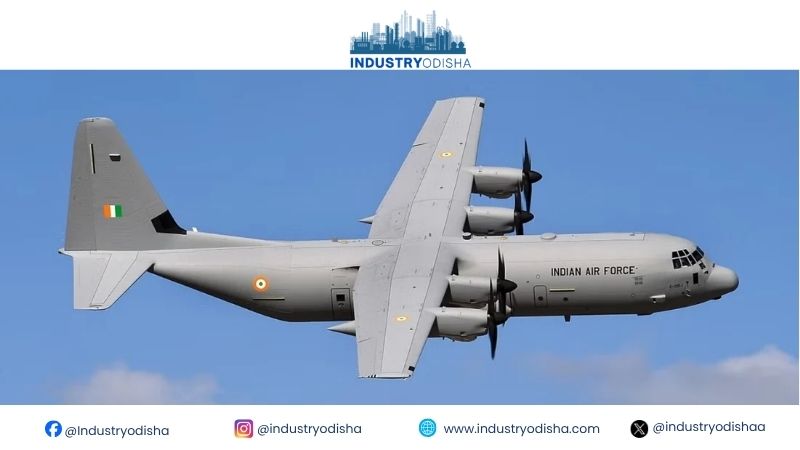
Industry Odisha Bureau, Oct 04: India wants 60 medium transport aircraft under a $10.5 billion tender. Lockheed Martin and Tata propose building 48 of them domestically. The bid could deepen India’s aerospace manufacturing base.
India’s next military airlifter may matter as much to factories as to airbases. The country’s medium transport aircraft tender is becoming a manufacturing contest. Lockheed Martin has made that shift explicit. The US company says it will expand production in India if its bid succeeds. Its Indian partner is Tata Advanced Systems Limited (TASL).
A 60-aircraft contest
India issued the tender in August for 60 medium transport aircraft. The procurement is valued at $10.5 billion. Five Indian companies are in the fray. TASL, Mahindra Group and Adani Defence & Aerospace are among them. Hindustan Aeronautics Limited (HAL) and Reliance Defence complete the field. Each is expected to bring global aircraft manufacturers into the programme.
An old partnership, a bigger ambition
Lockheed and Tata are not new partners. Tata already produces components and empennages for the C-130J. The empennage is the aircraft’s tail assembly. Dan Tenney is Lockheed Martin’s senior vice president for global business development and strategy. He called the Tata arrangement a robust existing capability. He said Lockheed wants to expand it through production and other work in India. That expansion, however, depends on Lockheed and TASL winning. Tata’s current role covers parts, not complete aircraft.
Forty-eight aircraft made in India
The heart of Lockheed’s offer lies in its numbers. The company says 12 aircraft would arrive in flyaway condition. The remaining 48 would be manufactured in India. That means four in every five aircraft would be built domestically. Importing finished aircraft delivers capability but limited industrial depth. Building them at home is a different proposition. It would demand wider manufacturing and supply-chain activity within India. It could move Tata from component supply towards broader aircraft production. The available details do not specify localisation levels or technology-transfer terms. Those terms will decide how much value stays in India.
Global makers, Indian anchors
Lockheed is not the only foreign manufacturer courting Indian industry. Mahindra has joined hands with Brazil’s Embraer for the contract. The structure makes Indian groups the domestic base for global aerospace bidders. The outcome will shape which Indian company gains manufacturing scale.
A possible 72-aircraft fleet
Lockheed’s pitch also reaches the Indian Air Force’s current fleet. The IAF operates 12 C-130J aircraft. Lockheed has proposed upgrading them to the same advanced configuration. It says this could give the force a common fleet of 72 aircraft. The upgrade remains a company proposal, not an approved plan.
The existing fleet has logged more than 58,000 flight hours. It has flown high-altitude operations in Ladakh. It supported humanitarian missions during the Nepal floods. In 2023, it evacuated Indian nationals from Sudan. These missions show why tactical transport aircraft matter to military airlift.
Where procurement meets manufacturing
The tender serves two goals at once. The military need is clear: 60 medium transport aircraft. The industrial stakes are less settled and potentially more lasting. Lockheed’s offer rests on expanding an established Indian partnership, not just selling planes. Rival bidders are pursuing similar alliances with Indian groups. No winner has been chosen. India’s eventual choice will shape both its airlift capacity and aerospace industry.
