



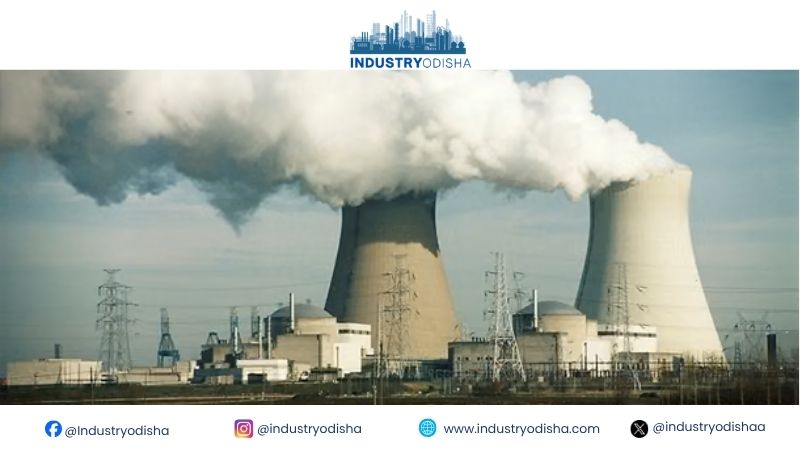
Industry Odisha Bureau, Oct 15: NTPC has proposed developing six reactors with Russia’s Rosatom for an estimated ₹1.5 trillion. The 6GW plan would draw on a 2014 India-Russia pact. It supports NTPC’s 30GW nuclear goal for 2047.
Since 1987, Nuclear Power Corporation of India Ltd (NPCIL) has been India’s sole nuclear generator. State-run NTPC Ltd now wants a larger role. It has proposed developing six reactors with Russia’s state-owned Rosatom, two people said. Capital expenditure is estimated at ₹1.5 trillion.
The proposal leans on an existing bilateral framework. In 2014, India and Russia agreed to build 12 reactors in India. NPCIL is developing six of them with Rosatom at Kudankulam, Tamil Nadu. Two are operating and four are under construction. The other six have yet to take off.
NTPC has asked that those remaining units be allocated to it. As a government-to-government pact, the allocation rests with the Centre, one person said. No decision on the allocation has been reported. NPCIL said it had no inputs on NTPC’s plans.
The price of six reactors
NTPC has offered to deploy Rosatom’s VVER-1000 design across all six units. Each would have 1,000MW capacity, adding 6GW in total. Industry estimates put nuclear capacity at ₹25 crore per megawatt. That arithmetic yields the ₹1.5-trillion figure. Nuclear projects demand heavy upfront capital and long build periods.
The six units would form one part of a far larger plan. NTPC targets 30GW of nuclear capacity by 2047. It has identified sites in Madhya Pradesh, Bihar and Odisha. Each could host 2–4GW, a third official said. Feasibility reports await Atomic Energy Commission approval.
NTPC’s nuclear subsidiaries, Anu Shakti Vidyut Nigam and NTPC Parmanu Urja Nigam, anchor that effort. Anu Shakti, an NTPC-NPCIL joint venture, is setting up 2.8GW in Rajasthan’s Mahi Banswara. NPCIL currently runs 24 reactors with a combined 8.78GW.
Why the bilateral route matters
Procurement may explain why NTPC prefers the Russian route. The Shanti Act opened India’s nuclear sector to foreign and private firms. Indian companies need global technology partners, who must come through tenders, this person said. Interested global players are reluctant to take that route. State-to-state pacts, such as the Russian one, offer a smoother path, the person added.
NTPC is also talking to other international firms. Those vendors would have to bid competitively. In April, NTPC signed a memorandum of understanding with France’s EDF on nuclear technology.
Nuclear power is not renewable, but it is a non-fossil source. It can supply steady baseload power and support grid stability as coal-based generation declines.
In August, minister Jitendra Singh outlined a two-pronged approach in the Lok Sabha. Large indigenous designs, such as 700 MWe pressurised heavy water reactors, target greenfield sites. Small modular reactors would target brownfield sites, including retiring fossil-fuel plants. They could also serve energy-intensive industries and remote off-grid areas. He said Shanti Act reforms would retain stringent safety and safeguards standards.
The long-term strategy remains India’s three-stage programme. It aims to use the country’s vast thorium reserves sustainably. Imported VVER designs sit apart from that indigenous path.
For NTPC, the Rosatom proposal is a test of execution. Allocation, approvals and Rosatom’s role all remain unresolved. Its outcome will show how far India’s nuclear sector can widen beyond NPCIL.
