



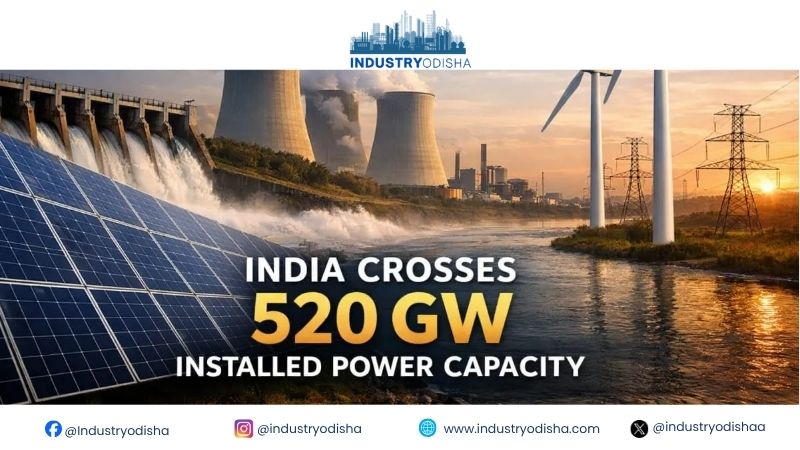
Industry Odisha Bureau, Sep 28: India’s installed capacity now exceeds 520 GW, and peak demand has hit 256 GW. Non-fossil sources make up over half that capacity. A Ficci-Nangia paper says grid stability must now keep pace.
Generation outpaces the old grid model
India has built power plants at a rapid clip. Installed capacity stood at around 382 GW in April 2021. By January 2026, it had crossed 520 GW. That is nearly 140 GW added in under five years.
Yet generating electricity is only half the task. The power grid must move it reliably, balance it and absorb shocks. A new Ficci-Nangia white paper argues those capabilities must now expand too.
Renewables change grid requirements
The generation mix has shifted sharply. In June 2025, non-fossil sources crossed 50% of cumulative installed capacity. That measures capacity, not the share of electricity actually generated. Still, the structural change is clear.
India’s grid was built around large coal, gas and hydro stations. Solar and wind operate differently. Their growth creates new requirements for how the system is managed.
Conventional plants traditionally supplied natural inertia and system strength. The paper notes the grid now operates with less of both. Inertia helps a power system resist sudden swings in frequency.
Demand adds another layer
Consumption is climbing at the same time. Peak electricity demand hit a record 256 GW in April 2026. Higher peaks raise the stakes for keeping supply and demand balanced. The grid must carry more power while adapting to new generation sources.
Eight pressure points
The white paper maps eight areas where the grid is under stress. Frequency and inertia top the list. Supply and demand must stay continuously balanced to keep frequency stable.
Voltage and system strength shape how the grid responds to disturbances. Power quality, protection and oscillations form related technical concerns.
Forecasting and congestion pose a planning challenge. Variable output is harder to predict, and transmission limits can restrict power flows.
The paper also flags resilience and black-start capability. Black-start means restoring parts of the system after a major shutdown. Modelling capability and cyber-physical security complete the eight. These are areas needing attention, not existing failures.
Making the wires work harder
The paper’s clearest technical call is to enhance existing infrastructure. It recommends grid-enhancing technologies alongside dynamic congestion management. The latter means responding to transmission constraints more flexibly. The goal is to extract more value from the network already built.
Hardware alone is not enough
Technical fixes need matching rules and institutions. The paper sets out 14 priority action areas across four levers. These span technical, regulatory and policy, market and commercial, and institutional capability.
On policy, it seeks market and contractual alignment. It also calls for stronger standards, testing and cybersecurity. Grid stability directly affects investment confidence in the energy transition, the paper argues.
The next phase of the transition
Suraj Nangia, managing partner at Nangia Group, highlighted the scale of recent additions. Flexibility, transmission and institutional capacity must now grow alongside generation, he said.
From megawatts to system capability
India’s energy transition has so far been measured in megawatts added. The next test is whether the wider system keeps pace. Transmission, flexibility, technology and regulation will increasingly define grid readiness.
