



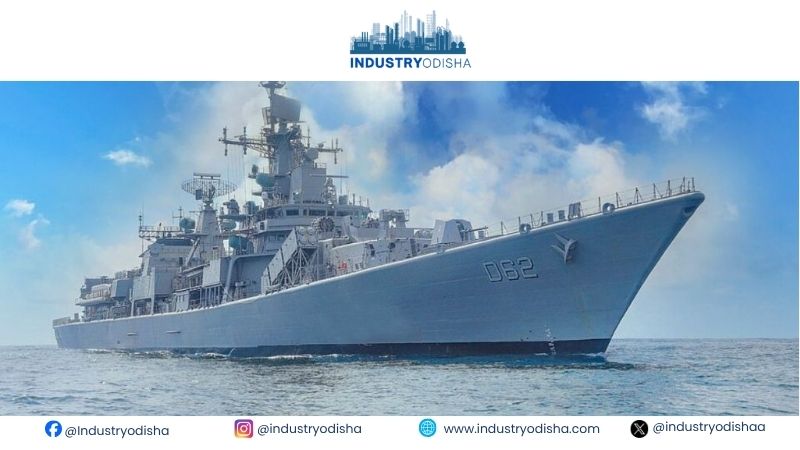
Industry Odisha Bureau, Sep 26: Indigenous naval simulators let Indian crews rehearse combat, navigation and emergencies ashore. They can help cut the cost of training at sea. Live exercises, however, remain essential.
Modern warships and submarines are among a navy’s most valuable operational assets. Yet crews must rehearse complex combat scenarios again and again.
Doing so at sea requires fuel, large crews and precious operational hours. Some scenarios, such as submarine attacks or incoming missiles, are too risky to repeat.
India’s growing simulation ecosystem is stepping into that gap. Indigenous simulators now let sailors practise ashore before their ships sail.
Naval Warfare Moves Into the Simulator
A ship-handling simulator recreates the working environment of a warship’s bridge. It reproduces navigation equipment, radar and communications. It can also simulate changing weather and different sea conditions. Even propulsion configurations can be varied.
Crews can practise emergencies and tricky manoeuvres repeatedly. None of this requires taking a real vessel out to sea. Each scenario can be run until responses improve.
Rehearsing Naval Combat Without Deploying Fleets
The value of simulation grows once training shifts from navigation to combat. The Action Speed Tactical Trainer, or ASTT, recreates a naval battlespace. That virtual space can include submarines, warships and other assets.
Radar, sonar and other sensor feeds are reproduced for trainees. Opposing teams then fight simulated engagements against each other. Commanders can test tactics and decision-making without deploying actual platforms.
ASTT is a training system, not an operational combat system. Its engagements are rehearsals, not evidence of real combat performance.
Training Across Multiple Warfare Domains
The simulation portfolio stretches well beyond ship handling. It covers anti-submarine warfare, anti-air warfare and electronic warfare. Mine warfare and amphibious operations are also included. So are submarine navigation and deep-submergence rescue training.
Several involve scenarios that are hard to stage safely and repeatedly.
Indigenous Simulators Add Strategic Flexibility
Building these systems in India brings a practical advantage. Training environments can be tailored to Indian platforms and geography.
Users can customise maps and threat profiles to their needs. Drone profiles can also be adapted for specific training requirements.
That flexibility lets crews rehearse scenarios relevant to Indian conditions. It supports defence indigenisation, though it does not mean complete self-reliance.
Cutting the Cost of Training at Sea
Simulation also changes the economics of naval training. Rehearsing a contingency live may mean assembling several ships at sea. Each run then consumes fuel, crew time and operational hours.
A virtual scenario can be repeated without deploying those assets every time. That can reduce training expenditure, though no precise savings figure is available.
As naval platforms grow costlier to run, that trade-off matters more.
Zen Technologies’ Simulation Footprint
Zen Technologies is among the Indian firms building such systems. It has a naval simulation facility in New Delhi.
The company says it has more than 1,500 operational naval and marine systems. It says these are spread across over 60 countries. Those figures are the company’s own.
Simulators Supplement, Not Replace, Time at Sea
Simulation does not remove the need for live naval exercises. Real warships, crews and sea time remain essential to readiness.
What simulators add is repetition without tying up real assets. Crews can face a crisis many times before meeting it at sea.
For Indian crews, that could mean sharper preparation before warships leave harbour.
