



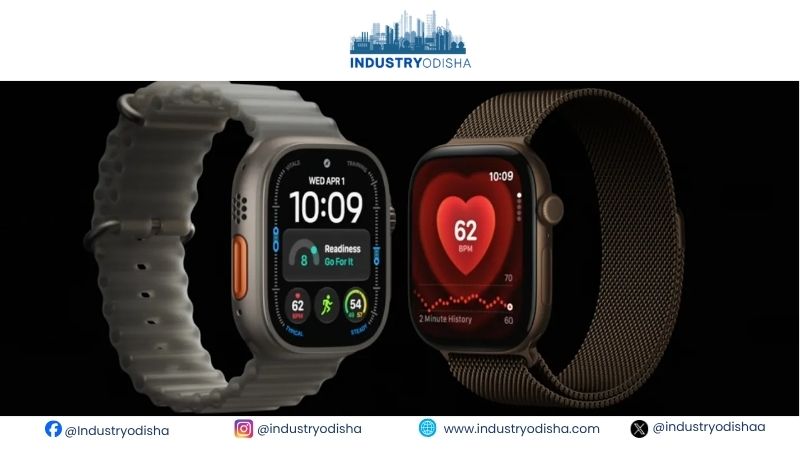
Industry Odisha Bureau, Sep 23: Apple’s new watches can listen to the sound around their wearers all day. They transcribe conversation snippets on demand and summarise what they hear. For Apple Watch privacy, the harder question is now consent. The person wearing the watch chooses. Everyone else simply talks.
That tension sits at the heart of Apple’s latest wearable AI push. The new watches, including the Apple Watch Ultra 4, can listen throughout the day. They can transcribe a snippet of conversation on demand. They can also turn what they hear into AI summaries. Yet these features raise fresh questions about recording consent for people nearby.
Ambient AI Arrives on the Wrist
The watch can listen to the sound around its wearer all day. Two features carry this capability: Live Rewind and Siri Recap. Both combine voice transcription with artificial intelligence.
Live Rewind Signals Its Presence
Live Rewind works strictly on demand. When prompted, it transcribes the previous 15 seconds of speech. Activation triggers a chime, an on-screen animation and a microphone indicator. These signals warn people nearby that their words are being processed.
Siri Recap Works Quietly
Siri Recap behaves differently. Its always-on listening runs all day, later producing on-device summaries. Unlike Live Rewind, it offers no equivalent continuous notice.
Apple markets both capabilities as opt-in. However, only the wearer makes that choice. Others in the conversation may not realise a summary is being built.
Security Is Not Consent
Apple says audio is never stored as a conventional recording. It says nothing is attributed to any individual speaker. Content is encrypted, and Apple says even it cannot read it.
Those safeguards address data protection, not consent. Information scientist Helen Nissenbaum offers a useful lens called contextual integrity. It holds that information should flow according to the norms of its setting. Words shared at a dinner party carry different expectations from a television broadcast. Wearable AI could quietly shift those expectations. Privacy laws requiring consent from recorded people may also come into play.
Apple’s Technical Safeguards
Apple’s Private Cloud Compute powers the new features. According to Apple, its staff cannot read what passes through the system. The servers keep no logs, the company says. They retain nothing once a user’s answer is returned.
Apple has also promised to publish the software behind each instance. Independent researchers could then check that it works as described.
Wearables Test Social Norms
Meta’s recording-capable smart glasses have been banned in some workplaces and venues. A recent crop of AI pendants raises similar questions. Settings that depend on confidentiality may prove especially sensitive.
Apple has shaped social norms before. AirPods made constant earphone wearing ordinary. The Vision Pro goggles, launched in 2024, have not won the same acceptance.
A Test of Trust
Apple paid US$95 million in 2025 to settle a Siri case. The claims concerned accidental activation and private audio reaching contractors. Apple did not acknowledge wrongdoing and says privacy remains its focus.
Its engineering may make ambient listening technically private. Whether people around each wrist accept it is a separate question. That answer will come from social norms, not servers.
