



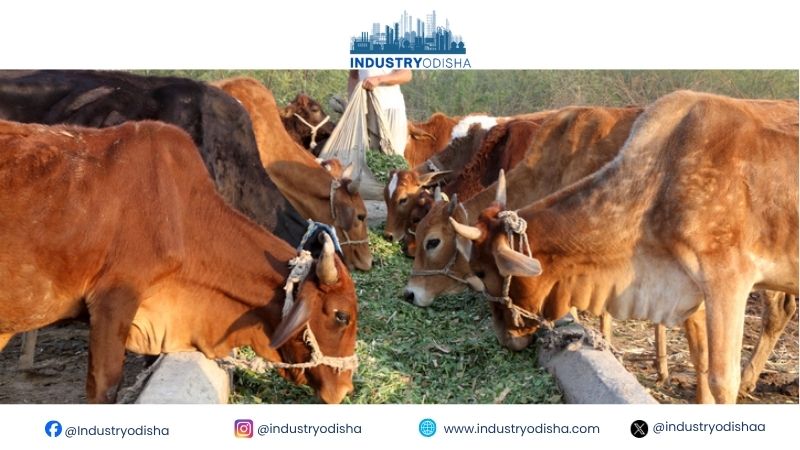
Industry Odisha Bureau, Oct 30: PM Modi cites higher daily milk yields. Cattle dung could expand dairying’s economic value beyond milk.
India’s average daily milk yield per cow or buffalo has reached about eight litres. Prime Minister Narendra Modi made the claim in Banaskantha, Gujarat, on October 30. He said the figure stood below five litres in 2013-14. He also dedicated a cattle breeding centre and laid foundations for two Bio-CNG plants. Together, they aim to expand the economic value of dairying beyond milk.
India is already the world’s largest milk producer. Modi said its milk production is also growing faster than any other country’s. But total output and yield per animal are different measures. India’s vast herd lifts total volumes even when individual yields stay modest. The eight-litre figure is a national average, not a uniform result across states or breeds.
The new Bharat Bovine Breeding and Research Centre sits on 127 acres at Bhildi. It is India’s first centre dedicated to the Kankrej cattle breed. It will use genetic improvement and advanced reproductive technologies. It will also work on Gir and Sahiwal cattle and Mehsana and Jafarabadi buffaloes. Modi said the centre could speed up breed improvement 10 to 20 times. That refers to the pace of breeding, not a matching jump in milk.
Better utilisation of cattle dung and agricultural residue is the other big bet. The two Banas Dairy Bio-CNG plants will come up at Tharad and Radhanpur. They are designed to process 175 tonnes of cattle dung daily. Dung is digested into biogas, purified into Bio-CNG, with slurry used as fertiliser. “We want farmers to also earn from cattle dung alongside milk,” Modi said. Plant capacity, however, is not the same as gas output or farmer income. Earnings will depend on dung prices, collection costs and demand for Bio-CNG and fertiliser. Cooperatives like Banas Dairy can help by gathering dung from many scattered farms.
Modi also said government schemes had helped farmers earn or save ₹50 lakh crore. He cited ₹4.5 lakh crore under PM-KISAN and ₹24 lakh crore in MSP payments. He added ₹16 lakh crore in fertiliser subsidies and ₹2 lakh crore in crop-loss claims. These are transfers, purchases, subsidies and claims, not one measure of farmer income. Under PM-KUSUM, 12 lakh solar pumps have cut diesel use, he said.
Modi dedicated 521 Agriculture Infrastructure Fund projects with a total cost of about ₹4,950 crore. He released the 24th PM-KISAN instalment of ₹19,000 crore. Work also began on 12 horticulture clusters across 1.46 lakh hectares.
Higher yields do not automatically mean higher profits. Feed costs, animal health and procurement prices shape what dairy farmers actually keep. The breeding centre and Bio-CNG plants could add real value over time. Lasting gains, though, depend on good science, strong cooperatives and paying markets. Only then will more milk and dung become higher net farm incomes.
