



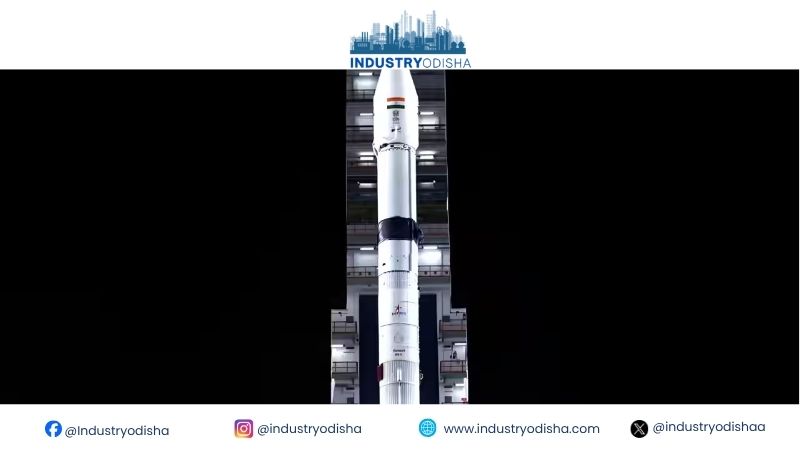
Industry Odisha Bureau, Oct 30: ISRO is set to launch NVS-03 at 11:51pm on Friday. The satellite must help revive NavIC, India’s homegrown answer to GPS. Since March, NavIC has been unable to fix positions on its own. Only three of its satellites still broadcast navigation signals. Minister Jitendra Singh told the Lok Sabha on July 29 that four are needed. Its timing service, however, continues to work.
India approved NavIC in May 2006 to cut reliance on foreign systems. The US runs GPS, Russia runs Glonass, Europe runs Galileo and China runs BeiDou. Japan operates QZSS, a regional system much like NavIC. An ISRO official told Hindustan Times in 2023 that military-run systems can be degraded or denied. NavIC covers India and about 1,500km beyond its borders, free for civilians. It supports fishing vessels, locomotives, disaster alerts and some smartphones. Banks, exchanges and the military also need precise time. That is separate from India’s new ground-based atomic clock network for official time.
Each satellite broadcasts its position and the exact moment it sent the signal. A receiver measures the delay and converts it into distance. Radio waves cover roughly 300 metres in a millionth of a second. So a tiny phone clock error can misplace a user by hundreds of metres. Three satellites fix a point; a fourth corrects the receiver’s clock error. Each satellite therefore needs working atomic clocks to be useful.
All three atomic clocks on IRNSS-1A, made by Swiss firm Spectra Time, failed. Its replacement, IRNSS-1H, was lost in 2017 when its heat shield did not separate. IRNSS-1I reached orbit in 2018 with a fix for an overheating capacitor. A March 2018 CAG report blamed delays on poor contract execution and weak monitoring. The system began operating that year, nearly seven years behind schedule. In January 2025, NVS-02 never reached its working orbit. An ISRO inquiry found a signal failed to reach a pyro valve. That single-use valve opens with a small explosive charge. Without it, the satellite’s own engine could not fire. The rocket had done its job; the spacecraft’s propulsion had not.
GSLV-F18 will drop NVS-03 into an oval orbit between 170km and 37,000km. The satellite must then fire its own engine to reach its circular slot. Singh told Parliament in August that NVS-02’s lessons have been built in. NVS-03 carries an Indian-made atomic clock alongside imported ones, ISRO said. It also adds the civilian L1 signal, easing use in smartwatches and cheaper gadgets.
IRNSS-1B, launched in 2014 with a 10-year design life, is now in its 13th year. NVS-04 and NVS-05 are in an advanced stage, Singh said in July. One more satellite will complete the seven-satellite core. Former ISRO chief S Somanath has spoken of medium-earth-orbit satellites for global reach. That remains an ambition, not an approved programme.
A clean launch and orbit-raising would restore standalone positioning for now. Lasting reliability needs timely replacements, sturdier clocks and dependable domestic components. Until then, NavIC will stay one satellite failure away from losing positioning again.
