



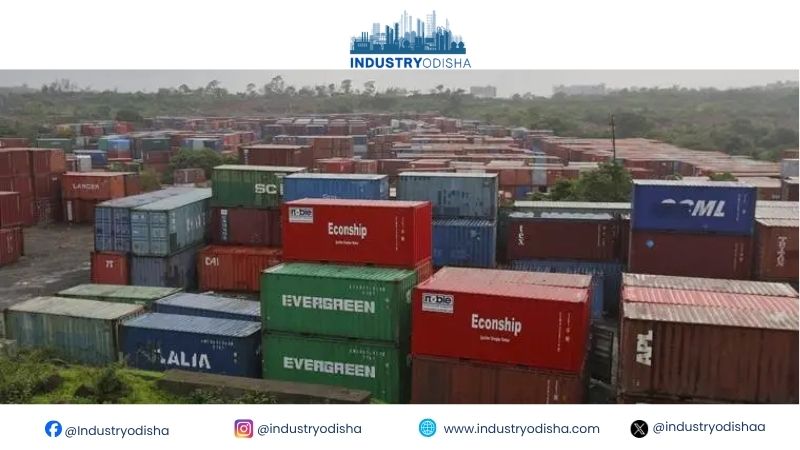
Industry Odisha Bureau, Oct 30: India wants to build its own shipping containers at scale. The Union Cabinet approved a ₹10,000-crore support scheme on 28 October. It aims to lift yearly capacity from 70,000 TEUs to 7.5 lakh by FY40. A TEU, or twenty-foot equivalent unit, measures one standard 20-foot box. The move ties container supply directly to India’s export ambitions.
The challenge is stark. China built over 97% of the world’s containers in FY26. India’s share was just 0.5%, the National Shipping Board’s annual report shows. China produced about 6.45 million TEUs in 2025, its industry association reported. That output rests on clustered factories, cheap local steel and huge export volumes. China is also the world’s largest steel producer. Long ties with shipping lines and suppliers deepen its lead.
Most of the money will subsidise running costs, not new plants. About ₹8,891 crore goes to production-linked operating support. Another ₹859 crore covers interest subsidies, and ₹150 crore funds testing and certification. Those three items total ₹9,900 crore; Mint did not itemise the remainder. Makers will earn ₹49,500 per 20-foot box and ₹86,625 per 40-foot box. Specialised 20-foot units will attract between ₹37,125 and ₹74,250 each. The package also offers concessional port leases and runs for 13 years. The plan is smaller than an ₹11,000-crore incentive proposal Mint reported in 2024.
Supply security is the core argument. During April’s West Asia conflict, mango exporters struggled to find refrigerated containers. They turned to costlier alternatives while freight rates also climbed. Shankar Shinde of Global Express Multilogistics told Mint domestic production would cut shortage risks. He added that Indian-made boxes could also move local freight, unlike imported ones. Yet factory output alone does not guarantee boxes reach exporters. Shipping lines and leasing firms control most boxes and move them along global routes.
Steelmakers stand to gain first, as containers are mostly steel. Makers of corner castings, wooden floors and paints could also benefit. Ports may gain too, with new deep-water hubs planned at Vadhavan and Galathea Bay. The shipping ministry projects about 3,000 direct and 50,000-plus indirect jobs. It also estimates ₹75,000 crore in economic output by FY40. These are official projections, not outcomes, and output is not profit.
The math raises questions. Minister Ashwini Vaishnaw wants India to win 15–20% of global production by FY40. At today’s volumes, 7.5 lakh TEUs would equal roughly a tenth of world output. Capacity also differs from actual production, which depends on firm orders. Indian makers must match Chinese costs, quality and international certification standards. They must also stay viable once subsidies taper off.
Success will show in real numbers, not targets. Watch production levels, plant utilisation, export orders and per-unit costs. Repeat purchases from global lessors and shipping lines will matter most. If those arrive, India could secure a lasting foothold in container making. If not, the scheme risks building capacity that sits idle.
