



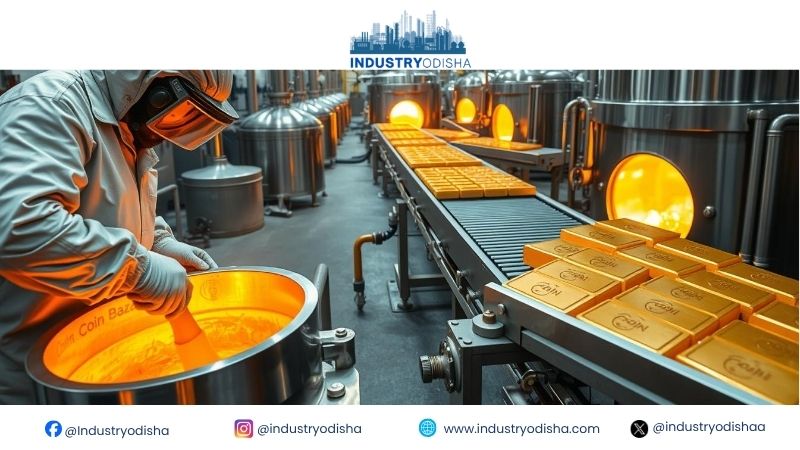
Industry Odisha Bureau, Sep 30: This is the gold paradox at the heart of India’s bullion market. The country is a refining giant, yet only a minor bullion exporter.
A new IIM Ahmedabad working paper says the problem is not a lack of refineries. Authors Bhavya Gupta and Sundaravalli Narayanaswami point to the weak links around them. These include sourcing, certification, duties and export channels.
Capacity is not production
Installed capacity measures what refineries could do, not what they actually do. World Gold Council figures show capacity rising from about 300 tonnes in 2013.
A survey of India’s organised sector found 27 operating refiners. Their combined capacity was 1,467 tonnes. Average utilisation, however, was only 20%. That points to actual throughput of roughly 293 tonnes a year.
Exports equalled less than 1% of that estimated output. Against installed capacity, they were just 0.12%.
India’s own appetite absorbs most refined gold. Demand was estimated at about 711 tonnes in 2025. The issue is not that everything should be exported. It is that very little reaches global buyers at all.
Imports swell, exports fade
India’s gold import bill more than doubled between FY2017–18 and FY2025–26. It rose from USD33.66 billion to USD71.98 billion. Physical imports actually fell 24.53% to 721,033 kg. Higher gold prices, not bigger shipments, inflated the bill.
Exports shrank on both counts. Their value fell 83.83% to USD242.55 million. Volumes dropped nearly 94% from 36,927 kg.
The gold trade deficit widened from USD32.16 billion to USD71.73 billion. By weight, exports now equal just 0.31% of imports.
Yearly swings have been sharp, but from a tiny base. Export value jumped 833% in FY2024–25, then fell 73.5%. Gold import duty was cut from 15% to 6% in July 2024. It returned to 15% on May 13, 2026. That reversal came amid rupee and current-account concerns. The study links the swings partly, not solely, to these duty changes. Its lesson is that exporters need predictable duties.
The missing passport
Global buyers want bars they can trust without questions. That trust comes from the LBMA Good Delivery List. LBMA is the London Bullion Market Association.
In August 2026, the list named 67 accredited gold refiners. India had just one: MMTC-PAMP in Haryana. China had 16, Japan 11 and Switzerland five.
Accreditation needs more than pure metal. Bars must meet standards for purity, dimensions and weight. Refiners must also prove responsible sourcing. That means traceability, anti-money laundering checks, documentation and independent audits.
The study finds Indian refiners strong on technical skills. Their responsible-sourcing systems, it says, still lag behind.
Building a home-grown stamp
IFSCA has proposed Good Delivery Guidelines 2025 as a domestic certification route. Refiners meeting its sourcing and audit rules could become IFSCA Accredited Refiners. They could then deliver gold on IIBX.
The study recommends upgrading eight to 10 Indian refiners by 2030. That, it argues, would create a critical mass of compliant capacity.
A domestic stamp, however, does not guarantee acceptance abroad. Foreign regulators, exchanges and counterparties must also recognise it. The authors see bilateral agreements and regulatory cooperation as the way there.
Turning IIBX into a two-way gate
The India International Bullion Exchange opened at GIFT City in July 2022. It offers trading, price discovery, clearing, settlement and vaulting. It connects banks, refiners, jewellers, suppliers and international participants.
Today, its role is mainly import-oriented. The study wants it to become a two-way gateway. Eligible Indian refiners could then export refined gold and silver through it. That would need new regulatory and operational mechanisms.
Even then, the exchange cannot create competitiveness alone. It needs certified bullion, doré, scrap, stable duties and smooth export procedures.
What global hubs teach
Doré is semi-refined gold that comes from mines. Switzerland imports doré, refines it and re-exports finished bars. Japan leans on recycling, including metals recovered from electronic waste. Dubai pairs its own Good Delivery standard with a UAE government-backed one.
The authors suggest a similar dual track for India. A sovereign Indian standard would work alongside LBMA certification. They also propose credit for duties paid on qualifying doré imports. This could ease refiners’ working capital and help formal supply compete with smuggling.
The missing links
India does not need more refineries first. It needs the links between its refineries and the world. Gold must flow from mine or scrap to refinery, certification, IIBX and overseas buyers.
The study seeks coordination among RBI, DGFT, BIS, SEBI and IFSCA. It also urges wider doré sourcing from Africa and Latin America. Its vision is a credible Indian bullion hub by 2030. Getting there depends on connecting pieces that still work apart.
