



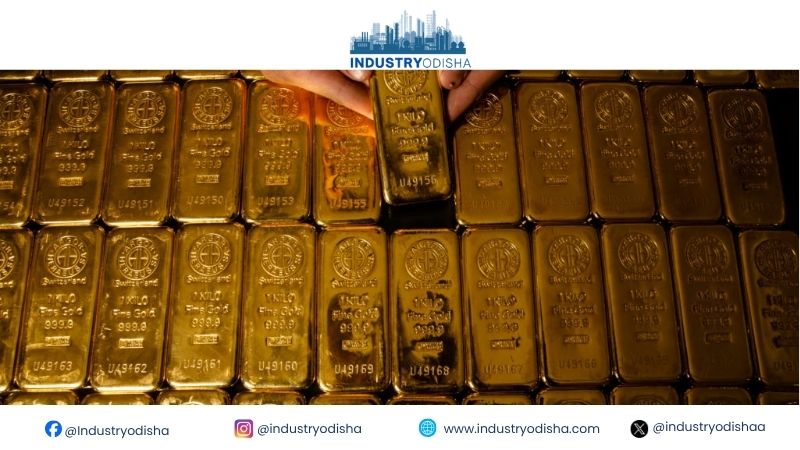
Industry Odisha Bureau, Sep 30: India can refine about 1,800 tonnes of gold a year. Yet it shipped just 2.2 tonnes abroad in FY26. Idle plants, scarce certification and shifting duties explain the gap.
India has built one of the world’s largest gold refining networks. Installed capacity reached about 1,800 tonnes by 2021, says the World Gold Council. In 2013, it stood near 300 tonnes.
Yet India exported only 2,228 kg, about 2.2 tonnes, in FY2025–26. For a refining giant, it remains a surprisingly small bullion exporter.
A new IIM Ahmedabad working paper examines this gold paradox. Authors Bhavya Gupta and Sundaravalli Narayanaswami say capacity is not the main problem. The real gaps lie in sourcing, certification, duties and regulation.
Plants running at a fifth of potential
Installed capacity tells only part of the story. A survey of India’s organised sector found 27 operating refiners. Together, they could process 1,467 tonnes a year. On average, however, they used only 20% of that capacity.
That implies actual throughput of roughly 293 tonnes. Exports equalled less than 1% of this estimated output. They were just 0.12% of installed capacity.
Most refined gold naturally serves India’s vast domestic market. Demand was estimated at about 711 tonnes in 2025. Still, the gap shows how little reaches global buyers.
Import bill doubles, exports shrink
India’s gold import bill rose from USD33.66 billion to USD71.98 billion. That covers FY2017–18 to FY2025–26. Physical imports, however, fell 24.53% to 721,033 kg. Higher gold prices, not larger shipments, drove the bigger bill.
Exports moved the other way. Their value dropped 83.83% to USD242.55 million. Volumes shrank nearly 94% from 36,927 kg.
The gold trade deficit widened from USD32.16 billion to USD71.73 billion. By weight, exports now equal just 0.31% of imports.
The certification gatekeeper
Global buyers trust bars carrying recognised quality stamps. The London Bullion Market Association (LBMA) sets the key benchmark. Its Good Delivery List named 67 accredited gold refiners in August 2026.
India had only one: MMTC-PAMP in Haryana. China had 16, Japan 11 and Switzerland five.
Accreditation has two parts. The first covers purity, dimensions and weight. The second covers responsible sourcing. That means traceability, anti-money laundering controls, documentation and independent audits.
The study says Indian refiners have improved technically. Their responsible-sourcing systems, however, remain underdeveloped.
Shifting duties, shifting exports
The July 2024 Union Budget cut gold import duty from 15% to 6%. It returned to 15% on May 13, 2026. The reversal came amid rupee and current-account concerns.
Export value jumped 833% in FY2024–25, then fell 73.5%. These swings come from a very small base. The study does not blame duties alone. It argues unpredictable duties invite arbitrage and discourage steady exports.
Can IIBX open an export route?
The India International Bullion Exchange (IIBX) at GIFT City offers one possibility. IFSCA’s proposed Good Delivery Guidelines 2025 would create a domestic accreditation path. Qualifying refiners could deliver bullion on IIBX after meeting sourcing and audit rules.
The paper backs a dual-track system. An Indian standard would sit alongside LBMA certification. Overseas acceptance, though, would not be automatic.
The authors also propose credit for duties paid on qualifying doré imports. Doré is semi-refined gold shipped from mines for final processing. The credit could ease refiners’ working-capital burden. It could also help formal sourcing compete with smuggled supplies.
Lessons from global hubs
Switzerland imports doré, refines it and re-exports finished bars. Japan relies on recycling, including metals recovered from electronic waste. Dubai built a commodities ecosystem backed by dedicated accreditation rules.
Refineries are only the start
India already has the plants, the skills and the demand. The missing links are institutional and commercial. Gold must flow smoothly from sourcing to certification, exchange and export.
The study urges coordination between RBI, DGFT, BIS, SEBI and IFSCA. It also backs wider doré sourcing from Africa and Latin America. Its ambition is a credible Indian bullion hub by 2030. That depends on joining pieces that remain largely disconnected.
