



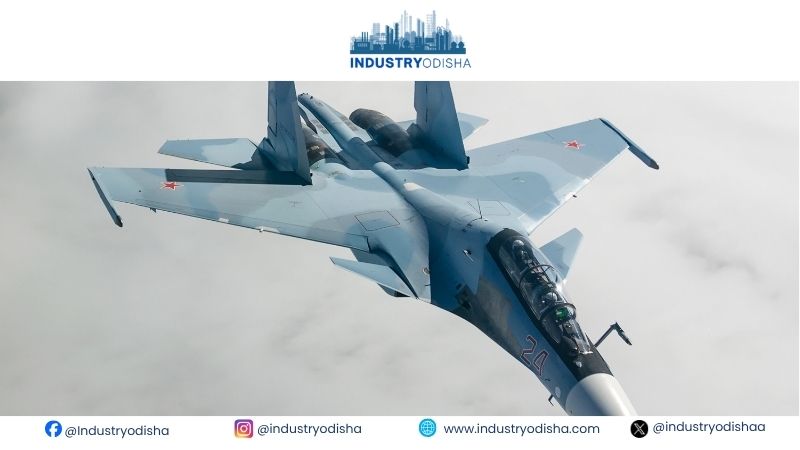
Industry Odisha Bureau, Sep 18: Russia is pushing India to manufacture the Su-57 stealth fighter locally. The proposal seeks to replicate the successful SU-30 MKI manufacturing model. Moscow wants Indian companies deeply integrated into the fighter’s global supply chain. The plan could significantly expand India’s advanced aerospace manufacturing capabilities.
SU-30 MKI Model Shapes Proposal
Russia views the SU-30 MKI programme as a proven industrial template. That programme helped build substantial manufacturing capability at Hindustan Aeronautics Limited. It also created a wider domestic aerospace supplier network. Russia now wants similar industrial integration for the Su-57 stealth fighter. However, fifth-generation manufacturing would require more advanced infrastructure.
India Could Become Supply Chain Hub
The Russian proposal goes beyond aircraft assembly for India. Indian manufacturers could supply components for Russian and export aircraft. That would make India part of the Su-57 production network. Such participation could improve access to advanced aerospace technologies. It could also deepen manufacturing expertise across Indian defense companies.
IAF Requirement Appears More Limited
India’s immediate operational requirement may be significantly smaller. The Air Force reportedly prefers a limited direct purchase. That could provide faster access to fifth-generation capability. Large-scale manufacturing would require considerably higher financial commitments. That creates a gap between Russian ambitions and Indian requirements.
Manufacturing Scale Becomes Key Issue
Russia reportedly seeks a larger aircraft commitment from India. A bigger order would improve manufacturing economics. It could also justify major upgrades at HAL facilities. A smaller fleet may not support dedicated local production economically. This makes order size central to future negotiations.
Stealth Fighter Capability Fills Near-Term Gap
India currently lacks an operational indigenous fifth-generation fighter. The Su-57 stealth fighter could provide an interim capability. That could help address regional technological challenges. However, any acquisition must fit India’s broader defence priorities. Cost and delivery timelines will remain critical.
AMCA Remains Strategic Priority
India continues developing its indigenous Advanced Medium Combat Aircraft. AMCA remains central to long-term aerospace self-reliance. A large Su-57 manufacturing programme could compete for resources. Funding pressure could affect domestic development timelines. That makes procurement strategy particularly sensitive.
Technology Transfer Could Add Value
Russia could offer technology transfer alongside local manufacturing. Such access may cover advanced aircraft systems and production techniques. That could strengthen India’s defence manufacturing ecosystem. The benefits would depend heavily on contractual terms. Meaningful technology access would be crucial for India.
HAL Could Play Central Role
HAL already has extensive experience with SU-30 MKI manufacturing. Its Nashik facility remains important for Russian-origin fighter production. That experience could support future Su-57 manufacturing discussions. However, stealth fighter production requires substantially higher technical standards. Additional investment would therefore be unavoidable.
India Faces Strategic Trade-Off
India must balance immediate capability with long-term manufacturing independence. Direct purchase could provide faster operational benefits. Local manufacturing could deliver deeper industrial gains. However, large commitments could reduce resources available for AMCA. The decision therefore extends beyond one fighter acquisition.
Russia Seeks Deeper Defence Partnership
For Russia, India offers both scale and manufacturing capability. For India, the proposal offers technology and industrial opportunities. The challenge lies in aligning those interests. The SU-30 MKI experience provides a strong historical reference. However, the Su-57 stealth fighter involves substantially greater complexity. India’s final approach will depend on cost, capability, and strategic priorities.
