



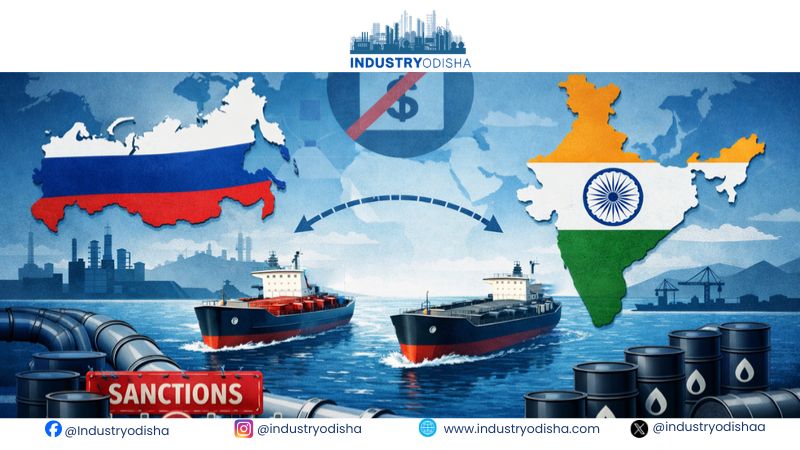
Industry Odisha Bureau, Sep 03: The Senate passed the Lindsey O. Graham Sanctioning Russia and Iran Act in twenty twenty-six. The legislation authorises tariffs of up to one hundred percent on countries. These include the five largest importers of Russian crude oil or natural gas. India faces particular exposure because Russian crude now represents roughly half of imports. Before the Russia-Ukraine conflict, Russian crude represented only approximately two percent of imports.
India has deliberately diversified its energy supplies to reduce crude import costs substantially. In twenty twenty-six alone, imports nearly doubled from four point five four MMT. The imports rose to eight point nine six million metric tonnes by May. This energy strategy has provided supply security and some strategic advantages for India. However, greater Russian oil dependence increases exposure to potential external trade restrictions significantly.
On July twenty-four, the U.S. imposed an additional ten percent forced-labour tariff on India. This replaced an expired ten percent duty under the earlier Section One Twenty Two. If the Russia Sanctions Act becomes law, India’s cumulative tariff could reach one hundred ten percent. Such high tariffs could substantially affect India’s price competitiveness in the U.S. marketplace. The United States remains one of India’s largest and most important export destinations.
Trade simulations using GTAP modelling reveal potential economic consequences of the proposed tariff framework. Under a sanction scenario with one hundred ten percent tariffs on India, welfare declines. The modelled analysis estimates welfare losses of nearly forty-six point six billion dollars. India’s GDP would contract by zero point zero two percent in the simulation. Aggregate exports would decline by five point one percent under the modelled scenario.
However, export diversification could substantially change India’s economic prospects under the same tariff environment. The diversification scenario uses an India-European Union free trade agreement as a diversification proxy. Welfare improves by approximately twenty-six point three billion dollars in the modelled diversification scenario. India’s GDP turns positive by zero point zero one percent in this scenario. Aggregate exports increase by three point one percent when India pursues market diversification.
India can mitigate tariff-related economic pressure through strategic export diversification beyond the U.S. market. European and alternative markets provide important outlets for additional Indian export growth opportunities. Complementary domestic reforms should include trade facilitation, non-tariff barrier removal and better logistics. Improved standards and movement toward higher-quality goods can strengthen India’s export competitiveness substantially. These combined strategies can enhance India’s long-term resilience against future geopolitical and trade shocks.
