



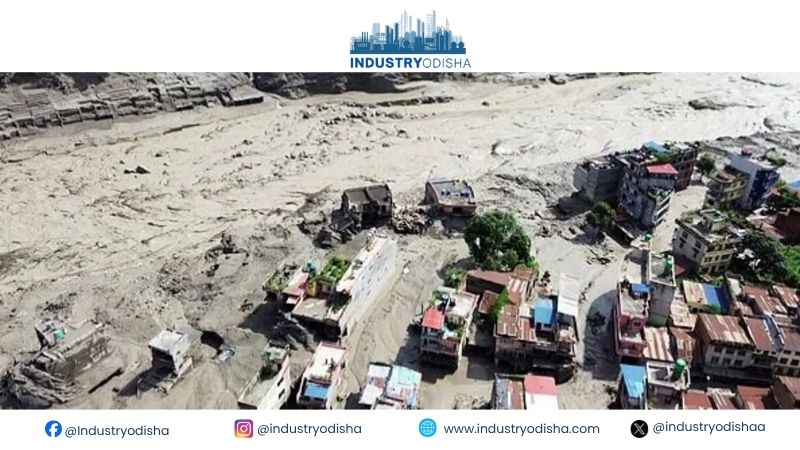
Industry Odisha Bureau, Aug 28: Chinese authorities warned that an artificial lake formed by debris blockage carries significant breach risk. Continued rainfall could increase water inflows to around three million cubic metres over three days. The lake’s failure could send floodwaters downstream, threatening areas including Gyirong Port and beyond. Meanwhile, rescue teams continue searching through thick mud for more than fourteen hundred missing.
The warning underscores an emerging secondary threat amid already devastating humanitarian emergency conditions. The disaster has killed at least three hundred ninety-two people across the Nepal-Tibet border region. Nepali police reported that three hundred eighty-nine bodies had been recovered so far from debris. In Nepal, nine hundred ten people remain unaccounted for, including five hundred seventeen foreign tourists. On China’s side, five hundred fifty-eight people remain missing, including two hundred sixty foreign nationals. The mudslide swept away entire settlements, bridges, vehicles and critical infrastructure in the region completely.
The artificial lake formed when massive mudslide debris blocked the river flow upstream completely. Water accumulated behind the debris blockage, creating a newly formed lake that now threatens. Continued rainfall increases water pressure against the debris blockage, raising the breach risk significantly. Chinese meteorologists forecast inflows could reach approximately three million cubic metres over three days. If the debris blockage fails, released water could surge downstream through narrow Himalayan river valleys. The debris barrier’s failure would create a rapid destructive flood wave affecting downstream communities. This secondary flood risk now parallels the ongoing rescue operations across the border region.
The US Geological Survey noted the event was initially called a magnitude four point four earthquake. However, seismic analysis indicated that glacial collapse and debris flow had triggered the actual disaster. The sudden collapse generated enormous volumes of ice, rock, mud and water moving rapidly downward. Scientists describe this phenomenon as resembling an “inland tsunami” due to its destructive power alone.
Chinese Premier Li Qiang visited the affected area to oversee emergency relief operations personally. China deployed nearly eight hundred emergency workers including sniffer dogs and speed boats for rescue. Nepal’s Flood Forecasting Division issued warnings about the growing artificial lake and flood risks downstream. The Himalayan region faces multiple overlapping hazards including intense rainfall, landslides, and glacial instability. Climate change can alter glacier stability and precipitation, potentially increasing mountain flood risk currently. River systems and their hazards cross international borders, requiring coordinated monitoring and early warning systems. Authorities must now monitor lake water levels, rainfall, and debris stability simultaneously as critical indicators. The initial flood created immediate tragedy; the blocked river may create the next emergency.
