


Bhubaneswar, Aug 25: Sundargarh does not lack mineral wealth. What it lacks is a dependable mechanism for turning that wealth into local income.
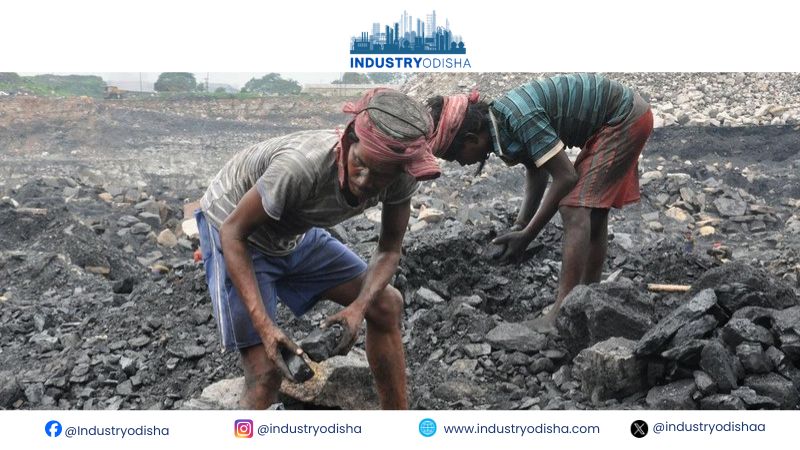
The district’s own survey documentation records iron ore, coal, manganese, limestone, dolomite and fire clay coal in the Ib river valley, limestone and dolomite around Biramitrapur and Lanjiberna, iron ore at Barsuan, Kalta and Gonua. The Department of Steel and Mines notes dolomite is abundant only in Sundargarh. The district hosts the Rourkela Steel Plant, cement and refractory producers, and industrial estates at Kalunga, Rajagangapur and Mandiakudar. Yet the same report records that more than half of Sundargarh’s people still depend on agriculture and allied activity for a livelihood, and official material cited in district mineral foundation planning places direct mining employment at roughly 15,000 persons in a district of over two million.
That distance between geological endowment and household income is the central problem, and it is not a failure of nature. It is what happens when an economy is organised around extraction rather than transformation. In an extraction economy the sequence is short: mine, load, move, sell. Value accrues where the mineral becomes something and that is usually somewhere else. In a value-added economy the sequence lengthens: beneficiation, processing, fabrication, components, servicing, logistics, testing, finished goods. Each additional link is a wage bill, a supplier invoice and a local revenue base.
Sundargarh’s missing element is the middle of that chain. The district has large mines and large plants. What it has less of is the dense layer of small and medium enterprises that ordinarily grows around industrial concentrations of this size engineering workshops, fabrication units, equipment maintenance firms, refractory and construction-material makers, packaging and logistics operators, testing laboratories, safety and environmental services, and the technical firms that support them. These are potential opportunities, not certainties, each depends on demand, capital and compliance. The economic logic is recognised in Odisha’s own policy. The MSME Development Policy 2022 identifies ancillary and downstream enterprises in the metals sector as a priority, and the Industrial Policy Resolution 2022 requires that land allotted to large projects be partly earmarked for ancillary and downstream units, alongside an MSME park in every district.
Employment is where this matters most immediately. Mineral-based MSMEs generate direct jobs on the shop floor, but their larger contribution is indirect and induced the transport contractor, the tool supplier, the vendor who services a crusher. No dependable district-level multiplier exists, and inventing one would be dishonest. The qualitative point stands regardless: a tonne of ore that leaves the district as ore supports one set of jobs; the same tonne processed, fabricated and serviced locally supports several.
Per capita income should be understood the same way as an outcome, not an announcement. Higher-value local production raises enterprise revenue, which raises wages and supplier earnings, which lifts household consumption and the local revenue base. Income per person rises when productivity per person rises, not when the number of registered units rises. Sundargarh’s development debate would improve by measuring the second rather than the first.
Sustainability is not decoration in this argument; it is the constraint that makes it credible. Small mineral-based units are precisely where dust, effluent, energy waste and worker injury are hardest to monitor and easiest to ignore. An MSME strategy without emissions control, water and energy efficiency, dust suppression, safe waste handling, land restoration and transparent monitoring will relocate environmental cost onto the communities that already bear it. The correct development target is more value from each tonne, not more tonnes.
That principle points naturally toward circularity. Industrial by-products slag, fly ash, fines, scrap and process residues are inputs waiting for an enterprise, provided the material stream and regulatory position are established rather than assumed. Recovery and reuse ventures can improve environmental performance and enterprise income at once.
Roughly half of Sundargarh’s population is tribal, and the mining-affected blocks identified in district planning Koida, Lahunipara, Gurundia, Hemgir, Kutra, Kuanrmunda, Nuagaon and Rajagangapur are rural. Participation here cannot mean employment alone. It means training tied to actual industrial demand, credit that reaches first-generation entrepreneurs, and procurement practices that make local vendors visible to large buyers. District Mineral Foundation resources cannot substitute for private capital and are not meant to. They can build the health, education, water and skilling base without which enterprise development in these blocks remains rhetorical provided the spending stays anchored to mining-affected areas rather than drifting to more visible addresses.
The obstacles are familiar and deserve naming: thin access to institutional finance, shortages of skilled technicians, unreliable industrial power, contested industrial land, compliance costs that fall hardest on the smallest units, quality certification, and dependence on a few large buyers whose payment cycles can break a small firm. None of these dissolve with an announcement. Each requires something duller: vendor-development programmes with real targets, common processing and testing facilities, cluster infrastructure, and a working link between Rourkela’s industrial base and the interior blocks’ workshops.
What Sundargarh should ask of itself is harder than a slogan: fewer tonnes celebrated, more products made. Its future will be measured in enterprises, skills and livelihoods created not in what it ships out.
Also Read: Odisha Receives Major Regulatory Clearances at 149th SLSWCA, Infrastructure Boost Expected
