



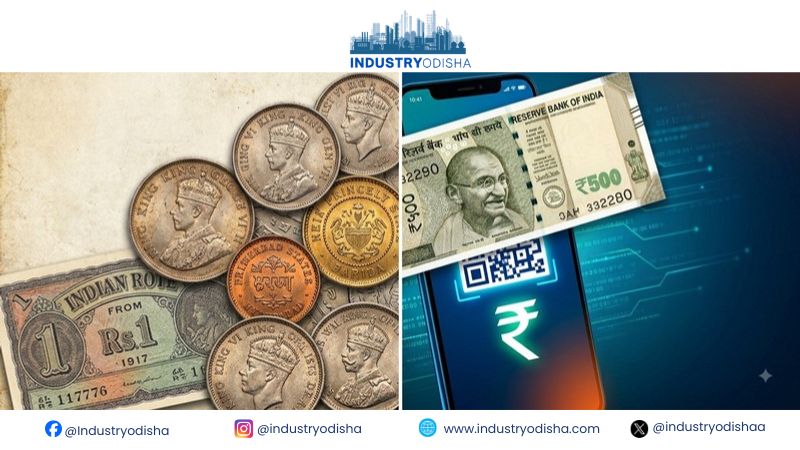
A Patchwork Before Rupee
The monetary system of India before 1947 seems almost unrecognisable. Before the rupee was the single currency as we know it today, people across the country used different currencies. The money varied according to which kingdom it came from. In some parts, the Maratha coins were used, while some princely states like Hyderabad had their own currency.
Briefly, India was a mosaic of coins and systems. The nation was also moving toward political integration. There was a currency change. The rupee began to take the place of other monies. The Reserve Bank of India (RBI) was set up in 1935 as the sole issuer of currency under one central authority. With independence, the way Indians counted their money changed completely.
Today, the rupee has moved from physical coins and notes to digital. It now adorns phone screens, flowing seamlessly on UPI and central bank digital currency (CBDC). At the same time, paper money is set for another round of change, with the Centre approving the Reserve Bank of India’s trials of polymer notes in 10 and 20 denominations. The RBI was not the first to print money in India.
Not always the state
The history of modern paper currency in India dates back to the late 18th century when private and semi-government banks started issuing their own notes. The Bank of Hindostan issued notes between 1770 and 1832. Later, the General Bank of Bengal and Bihar and the Bengal Bank were founded. Subsequently, three presidency banks, the Bank of Bengal, the Bank of Bombay, and the Bank of Madras, issued notes within limits.
When the Government Seized
That system changed. The Paper Currency Act, 1861, vested the exclusive right of issue of paper currency with the Government of India and abolished the issue of notes by private and presidency banks. RBI came into existence in 1935; the government continued to issue notes.
Except for one interesting thing. “RBI never issued the ₹ 1 note. It has always been owned by the Government of India. The first Rs. 1 note was printed on 30th November 1917. Silver was scarce during the First World War, and India had to substitute it with paper. It was printed in England and had a picture of the silver rupee coin, on which was the image of King George the Fifth.
Even after the formation of the RBI in 1935, the government continued to issue Rs 1 notes. The version introduced after independence in 1949 replaced the image of the king with the Lion Capital of Sarnath. This note is different from the currency notes issued by the Reserve Bank of India, as it is signed by the finance secretary and not the RBI governor.
The little note went out of India too. It was used as money in parts of the Persian Gulf, including Dubai, Bahrain, Muscat, and Oman, until 1970. Printing of ₹1 notes was stopped in 1994, as the cost of printing one ₹1 note was ₹1.48, which was much higher than its face value. That note was paid off in 2015.
Why did India want RBI?
By the start of the twentieth century, India’s financial system had become much more complicated. For years people had been making the case for a central bank.
The Royal Commission on Indian Currency and Finance, or Hilton Young Commission, in 1926 recommended the creation of a central bank. The Reserve Bank of India Act was passed in 1934, and the RBI commenced its operations on April 1, 1935. Since then, the RBI has taken over the management of currency from the government and is now the sole authority to issue banknotes in the country.
Rupee, Post-Independence
The British had left. But it wasn’t an instant makeover for the currency. Again, it was the Rs. 1 note that was the first banknote of India after independence in 1949. The Republic’s first coins went into circulation on 15 August 1950.
These coins, in turn, replaced the portrait of King George VI with the national emblem, the Lion Capital of Ashoka. But in reality, the monetary system was little changed: 1 rupee was still the equivalent of 16 annas.
In 1957, however, India decimalised its currency, and that changed. One rupee was made up of 100 paise. Initially, the new coins were named “naya paisa” to separate them from the old system. This change was not just a new set of coins for Indians used to annas and pice, but it was a new way of counting money altogether.
Banknotes were changing in design, too.
Mahatma Gandhi’s image was first printed on the ₹500 note in 1987. Then in 1996, the Mahatma Gandhi Series was introduced, and in 2016, the New Series of Mahatma Gandhi was introduced with redesigned notes, new dimensions, and enhanced security features. The RBI has, from time to time, enhanced these features by adding features like watermark, security thread, latent image, and colour shifting to make it difficult to counterfeit notes.
At the same time, prices eroded the purchasing power of the lower denominations. Gradually, some coins dropped out of use. Finally, in 2011, the government demonetised 25 paise and lower denominations.
Then Some Notes Disappeared
If memory serves correctly, on November 8, 2016, the government declared that old ₹500 and ₹1,000 notes would no longer be legal tender. India has demonetised high-value notes only twice before, in 1946 and 1978.
They have been replaced by a new series of currency. The first was the ₹2000 note, followed by the new ₹500 and ₹200 notes and new designs for other denominations with new security features.
But the ₹2,000 note had a shorter lifespan. It ceased printing it in 2018-19 and announced in May 2023 that it would be withdrawn from circulation under its clean note policy. Technically, the bill is still legal tender. But by April 2026, 98.45 per cent of the ₹2,000 notes in circulation at the time of withdrawal had been returned to the banking system.
The Indian currency has had quite a journey in less than a decade. This includes phasing out old ₹500 and ₹1,000 notes, introducing new ₹200 and ₹2,000 notes, and then slowly phasing out the ₹2,000 note as well.
When did the rupee get its identity?
For most of its history, the rupee was written as Rs. This was changed in 2010 with a special currency symbol of India, “₹.”
Then a national competition was held, and, in the process, D. Udaya Kumar, a postgraduate in industrial design from IIT Bombay, was declared the winner of the design. His design mixed the Devanagari “Ra” with the Roman “R.” The symbol started appearing on Indian currency notes and coins in 2011.
It was a small visual change, but a change with much more geopolitical weight. The rupee got its identity and became different from the dollar, pound, euro, and yen.
Wallet-to-phone
For centuries, money was simply coins and notes. Today an Indian can buy a cup of tea without a paisa of cash in his pocket. The rupee, now so minuscule, jumps from bank account to bank account with a scan or a few taps on UPI. And the RBI’s CBDC has taken that evolution a notch higher by introducing a fully digital form of sovereign money.
Cash is still very much a thing. The RBI’s annual report said the currency in circulation grew 12 per cent year-on-year to ₹41.23 lakh crore as of March 2026.
Altogether, the ₹500 note accounted for 86 per cent of the total value of notes in circulation.
The physical rupee now faces its next experiment. The government has cleared RBI trials of polymer Rs 10 and Rs 20 notes. One billion pieces of each denomination will be used in the field trials.
Polymer notes are expected to have a longer life than conventional paper notes. But the government has been clear that there are no plans to do away with paper money altogether. Polymer notes, if they come, will sit alongside paper notes.
The stuff is still in liquid form. The rupee has been reinventing itself for centuries, and this is just the latest chapter.
