



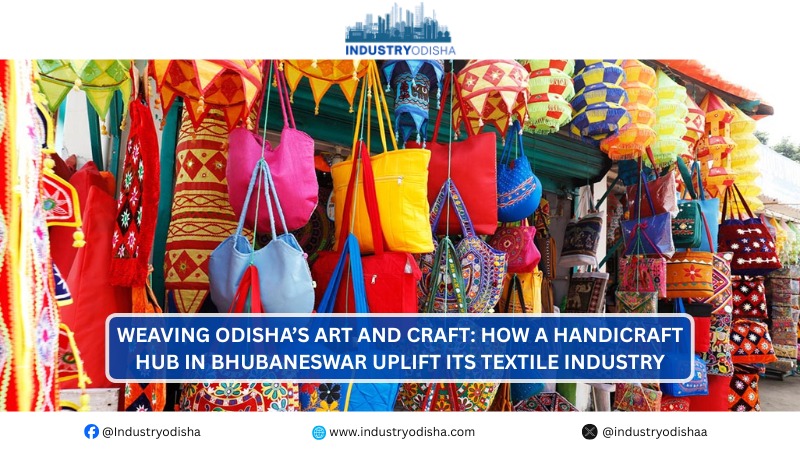
If reports are to go by, Bhubaneswar is all set to get a world class handicraft and handloom hub. Touted as a one-stop destination for traditional crafts and textiles, the upcoming complex aims to showcase Odisha’s rich artisanal heritage while improving market access for local craftsmen and weavers.
According to reports, the hub will house important government outlets such as Boyanika, Utkalika and Sambalpuri Bastralaya, ensuring that visitors can explore a wide range of authentic handloom and handicraft products under one roof.
Experts have hailed this move as Odisha’s textiles are not merely fabrics; they are stories woven in thread. From the intricate Sambalpuri Bandha to the elegance of Bomkai, Kotpad, Khandua and Berhampur Patta, Odisha possesses one of India’s richest handloom traditions.
The move comes at a time when Odisha is positioning itself as an emerging textile destination. For example, at Odisha Tex 2025, the state attracted investment intents worth ₹7,808 crore with projections of over 53,000 jobs in textiles and apparel.
Simultaneously, the state government has intensified efforts to modernise weaving, improve branding and strengthen market linkages for artisans and self-help groups.
Benefits
Branding advantage: It has been observed that Odisha’s textiles possess GI tags and extraordinary craftsmanship, yet many products lack premium market positioning. Sambalpuri sarees often compete with machine-made imitations because authentic branding and retail presence remain weak. Weak market networks have resulted in fading of authentic products. A centralised craft hub with fashion exhibitions, live weaving studios, international buyer-seller meets and digital showrooms could position Odisha textiles as luxury heritage products rather than regional commodities.
Market access: Despite having nearly 1.3 to 1.5 lakh artisans engaged in handicrafts and handloom sectors, the artisans of the state continue to depend on middlemen, limiting their earnings. An urban craft hub in Bhubaneswar, connected with airports, tourism circuits, and e-commerce logistics, could allow artisans from Bargarh, Nuapatna, Sonepur, Kotpad and Berhampur to directly access buyers.
Encourage innovation: Odisha’s textile sector has traditionally been strong in craftsmanship but weaker in adapting to changing fashion trends. Modern consumers increasingly seek fusion wear, sustainable fashion, handcrafted luxury, and designer collaborations. A craft hub housing textile labs, design institutes, incubation centres and collaborations with fashion schools could help Odisha’s weavers innovate without losing authenticity. The recent MoU signed by Mission Shakti for design mentoring and contemporary textile development shows that the state recognises this need.
Boost tourism and urban economy: Textile hubs across the world — from Jaipur’s craft markets to Istanbul’s Grand Bazaar — have become economic and cultural magnets. Bhubaneswar, already emerging as a smart city and tourism gateway, can leverage Odisha’s handloom heritage to create a distinct cultural economy. A vibrant art and textile district with museums, live workshops, craft cafés, performance spaces, and annual textile festivals could attract domestic and international visitors alike. Events like Sisir Saras already generate massive commercial activity for rural producers. A permanent textile and craft destination could multiply that impact year-round.
Preserve Odisha’s cultural identity: One of the biggest threats to traditional weaving is the migration of younger generations away from the craft due to low incomes and uncertain prospects. But when craft becomes aspirational, profitable, and globally visible, younger artisans return. A thriving ecosystem could encourage entrepreneurship in sustainable fashion, craft tourism, digital retail and textile exports. It would transform weaving from a declining inheritance into a viable modern profession.
At a time when global markets are increasingly valuing sustainability, authenticity and handmade excellence, Odisha’s textiles possess the potential to become international symbols of heritage luxury. What artisans need is visibility, innovation, and market access. A world-class hub can transform weavers from surviving craftsmen into global entrepreneurs. If Odisha succeeds in weaving together policy, design, tourism, and technology, Bhubaneswar can emerge as the loom on which the state’s next economic renaissance is crafted.
Read more: Odisha tops in rooftop solar adoption ULA Scheme in India
