



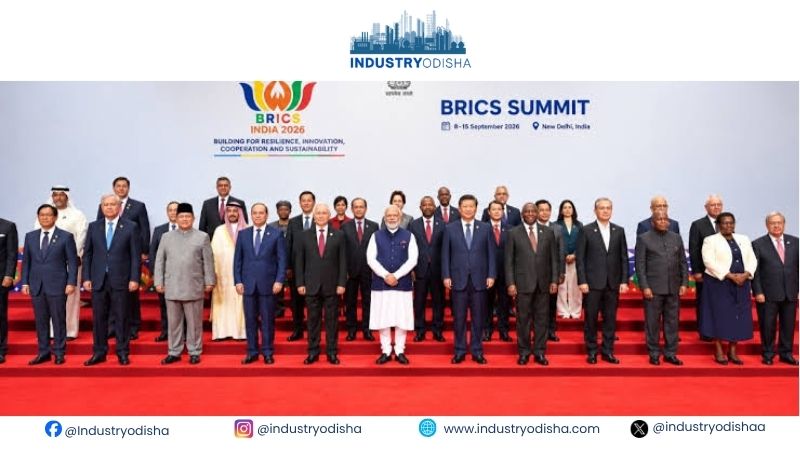
Industry Odisha Bureau, Sep 24: New Delhi hosted a BRICS summit crowded with rivals and rifts. Those very differences may give India more room amid great-power rivalry. Strategic autonomy is the prize at stake.
Few groupings contain as many quarrels as BRICS. Its members differ on security, trade, technology and much else. For India, that discord may be less a weakness than an opportunity. The 18th BRICS Summit in New Delhi, held on September 12–13, 2026, tested that proposition.
Optimists, Sceptics and the Policymaking Debate
Inside India’s policymaking community, BRICS rarely draws a neutral verdict. Optimists view it as a lever for a more multipolar world. Sceptics highlight its internal rifts and worry about Russian and Chinese sway. A third school sees little beyond annual symbolism. That camp would rather India concentrate on its US partnership.
Consensus Without Uniformity
BRICS brought 11 members to New Delhi. Among them were the UAE and Iran, whose relations remain tense. Even so, the summit produced the Delhi Declaration. Agreement came through compromise rather than shared strategic outlook. Some analysts suggest such friction can deny any single member control.
Multi-Alignment in Practice
New Delhi describes its approach as multi-alignment. That is not neutrality, nor equal distance from every capital. Washington remains a strategic partner of considerable importance to India. Yet India also keeps working ties with Moscow, Beijing, Tehran and Israel. BRICS adds one more table where several of these conversations can continue.
Tehran Visit Tests West Asia Balance
The summit followed US and Israeli strikes on Iran from February 28, 2026. India maintains close relationships with both Washington and Israel. It nonetheless welcomed Iranian President Masoud Pezeshkian to New Delhi. Earlier in September, India backed the SCO’s Bishkek resolution. That text condemned the strikes on Iran. It also offered condolences after Ayatollah Ali Khamenei was killed. Neither gesture signals Indian endorsement of Iran’s broader stance. Together, they show multilateral forums giving India room to recalibrate.
India-China Ties Need Guardrails
The India-China border question remains unresolved. Efforts to reset ties have, however, gained momentum. BRICS keeps both capitals talking when high-level visits are absent. Analysts describe the aim as “competitive coexistence”. That remains an aspiration, not a settled arrangement.
Tariff Threat From Washington
India faced US tariffs only months ago. On September 16, the US House passed a Russia sanctions bill. The bill seeks tariffs of up to 100% on countries including India. No such tariffs have yet been imposed. None of this makes BRICS a substitute for India-US cooperation.
Diverse Agendas, Narrow Common Ground
BRICS members take different positions on AI regulation, trade, finance and climate change. The grouping is neither an alliance nor a unified bloc. Its defenders argue members share wariness of unilateral action by any power. Compared with the G7, BRICS carries far greater political diversity.
What the Delhi Summit Means for India
BRICS gives India an extra channel, not a new camp. Its usefulness rests on flexibility amid persistent internal differences. Optimists and sceptics will read the Delhi summit differently. For now, it has kept India’s strategic options open. Whether that space endures amid great-power rivalry remains an open question.
