



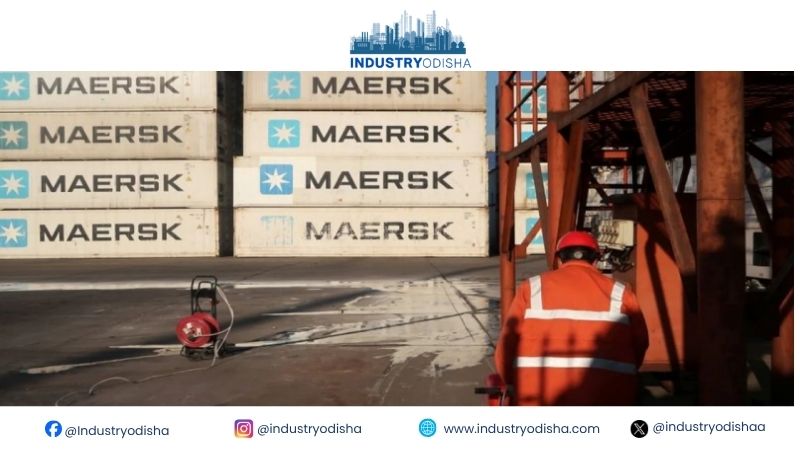
Industry Odisha Bureau, Oct 20: Maersk’s partnership with L&T reaches its first practical test at Kattupalli near Chennai. The planned drydocking of a container ship could showcase India’s growing ship-repair capability.
Danish shipping major A.P. Moller–Maersk will conduct its first planned drydocking in India. Its Singapore-flagged container ship, Maersk Chattogram, will enter Larsen & Toubro’s (L&T) Kattupalli Shipyard. The yard lies near Chennai in Tamil Nadu. The vessel is expected on 20 October, subject to operational and weather conditions.
It marks the first operational milestone since Maersk tied up with L&T. The two signed a Memorandum of Understanding (MoU) during India Maritime Week 2025. It set a framework to explore collaboration in shipbuilding and ship repair. It also covers sharing knowledge on global standards and building capability and capacity. The pact does not, by itself, guarantee future contracts or investment.
Drydocking means lifting a ship out of the water for inspection and repair. It lets engineers reach parts that normally sit below the waterline. For Maersk Chattogram, the work forms part of its normal lifecycle. It includes a scheduled special survey, a detailed check of the ship’s condition. Crews will also maintain and overhaul the hull, structure, machinery, equipment and propulsion systems. Such work keeps a vessel safe, seaworthy and reliable for the next five years.
The operation will use a specialised Shiplift system at Kattupalli. Maersk’s release describes it as the largest such system in India. A shiplift raises vessels vertically on a platform, then moves them onto land. Such heavy-lifting infrastructure is essential for servicing large commercial ships.
Dinesh Kumar Balraj heads Fleet Operations East at A.P. Moller–Maersk. He called the docking “a meaningful step towards turning our collaboration with L&T into action”. Maersk is aligning its global technical requirements with India’s shipyard and supplier capabilities, he said. He sees India becoming an increasingly important global maritime hub. Maersk would support that through long-term partnerships and knowledge sharing, he added.
Arun Ramchandani, Head of Precision Engineering & Systems at L&T, echoed that view. He said the docking advances the partnership under the MoU and a Framework Agreement. L&T aims to pair Maersk’s global expertise with its own shipbuilding capabilities. The goal, he said, is stronger domestic capabilities and supply chains.
The project will bring Maersk’s fleet and technical teams together with L&T engineers. Indian subcontractors, suppliers and maritime service providers are also expected to take part. The partners plan to focus on safe execution, quality delivery and knowledge exchange. Local firms could gain exposure to a global operator’s technical standards.
The development matters for India’s maritime ambitions. Greater domestic repair capacity could reduce the need to send ships abroad for maintenance. It could also build skills and deepen local supplier networks. One docking, however, will not make India a global hub on its own. Its success may shape whether more international operators bring ships to Indian yards.
