


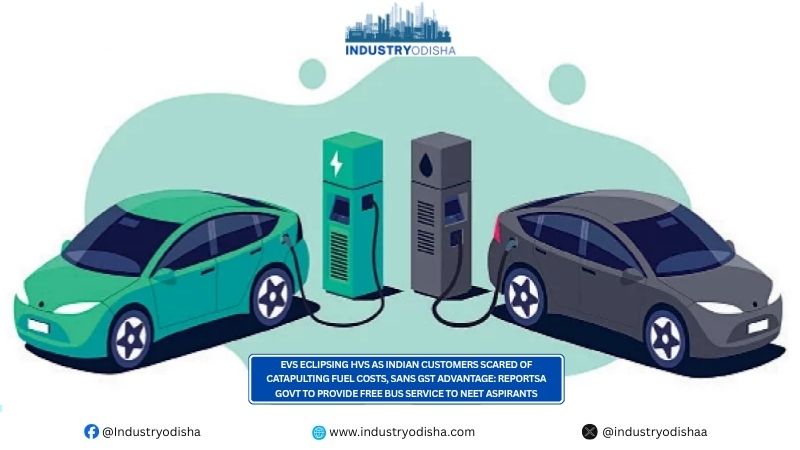
Industry Odisha Bureau, Jun 16: Smitten by the soaring fossil fuel costs as well as its ‘out of stock syndrome’ at the retail outlets these days at the time of need, along with the heavy amount of Goods and Services Tax (GST) being levied by the Union Government, Indian customers, capable of affording for vehicles, are reportedly preferring Electric Vehicles (EVs) to the Hybrid Vehicles (HVs).
Reportedly, “EV subsidies in India reduce the upfront cost of electric vehicles through central and state-level schemes, making EV adoption more affordable and promoting green mobility.”
Also reportedly, “All new EVs, including two-wheelers, three-wheelers, and four-wheelers, are taxed at 5% GST under HSN code 870240, regardless of personal or commercial use. The 56th GST Council meeting in September 2025 reaffirmed the 5% GST rate for EVs, while conventional vehicles now attract higher rates (18% for smaller vehicles and 40% for larger SUVs and high-engine capacity models. Additionally, the Ministry of Road Transport and Highways provides a 15% discount on third-party insurance premiums for EVs compared to conventional vehicles, further reducing ownership costs.”
On the contrary, “A hybrid vehicle is a car that combines two or more types of power, typically a gasoline engine and an electric motor, to improve fuel efficiency and reduce emissions. A hybrid vehicle uses multiple power sources to propel the vehicle, most commonly an internal combustion engine (ICE) and an electric motor powered by a battery. Unlike fully electric vehicles, most hybrids cannot be charged from an external power source, except for plug-in hybrid electric vehicles (PHEVs), which can be recharged and operate in electric-only mode for 20–60 miles depending on the model.”
As per reports, “The Government of India has recently proposed a subsidy for hybrid cars to encourage adoption of vehicles with lithium-ion batteries ranging from 0.5 to 2 kWh. The Department of Heavy Industries requested ₹13 crore to support 10,000 hybrid cars, reflecting a policy shift after lobbying by automakers like Toyota, Maruti Suzuki, and Honda. This subsidy is intended to make hybrid vehicles more affordable and complement the transition to electric mobility, recognizing that only 10–15% of vehicles are expected to be fully electric by 2030.”
Notwithstanding that, reports claim that “HVs are losing ground and pace in 2026 in comparison to the EVs even though the automakers are reportedly on their all-out efforts to revive the segment at par with the EVs.”
As per media reports, “Sales of hybrid cars recorded a year-on-year decline in sales for the first time since separate data became available in May 2026, with total volumes falling 1.3% to 8,421 units as against overall passenger vehicle industry growth of 25% to 404,000 units. EV sales, on the other hand, surged 81% to 26,682 units during the month, giving it a 6.6% share in total sales as against the 2.1% share of hybrids.”
Media reports also stated, “While large hybrid SUVs were taxed at 43% GST earlier, the traditional petrol/diesel-run large vehicles attracted 45-50% GST. Since all large vehicles now attract a flat 40% GST, HVs enjoy now no GST advantage.”
Media reports further stated, “Sales of traditional petrol/diesel-run large vehicles got boosted up due to a 5-10% cut in the GST, while HVs were left out with a mere 3% cut in the GST.”
Thus, the onus is on the HV automakers to launch soon a series of modified models and revised segments at par with need of the hour that is in sync with the EVs and the preference of the customers as well as eligible for the proposed subsidy to be given by the Government of India.
