



Industry Odisha Bureau, Sep 14: Packaged-food companies are cutting sugar, salt and saturated fats early. FSSAI’s proposed warning labels remain pending. Reformulation can take six to eight months, executives say.
Food and beverage companies are accelerating recipe reformulation in India. They are reducing sugar, salt and saturated fats. Changes span cookies, noodles, snacks, soft drinks and frozen foods. Companies are moving before FSSAI finalises its labelling framework.
FSSAI Warning Labels Accelerate Recipe Changes
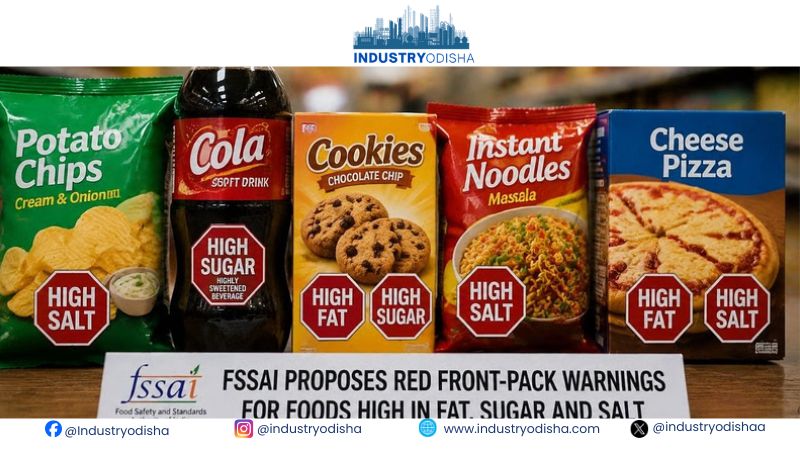
FSSAI has proposed red hexagonal front-of-pack warning labels. These would flag products with excess sugar, salt or saturated fats. The framework remains a draft proposal, not final law. Executives fear prominent warnings could affect consumer purchasing. Companies are therefore preparing ahead of any mandate.
Reformulation Can Take Six to Eight Months
An executive at a large snacks maker said companies aren’t waiting. Reformulating existing products can take six to eight months, the executive said. Reducing sugar and salt can also compromise taste. That makes reformulation more than a simple ingredient swap. Companies are fast-tracking research and development as a result.
Supreme Court Seeks FSSAI Clarity
The Supreme Court directed FSSAI to clarify implementation details on September 10. The regulator was given 10 days to respond. The order concerns the proposed warning-label framework. FSSAI’s proposal envisages a two-phase rollout. More than 60 global nutrition scholars have urged FSSAI to drop the requirement. The packaging debate has continued for roughly a decade.
Multinationals Move Ahead of Global Deadlines
Many global food companies already hold voluntary reduction commitments. These operate through the International Food and Beverage Alliance. Signatories include Coca-Cola, Nestlé, Danone, Kellogg and PepsiCo. Mondelez and Mars are also referenced among such commitments. Global programmes often specify four-to-five-year reduction timelines. Indian operations are now moving faster than those schedules, according to the report.
Nestlé India Continues Product Reformulation
Nestlé India’s FY26 annual report cites steady reformulation progress. The company says it continues reducing salt, added sugar and fat. Nestlé SA’s research arm supports reformulation and new product development. The company says this work also aims to preserve taste. Nestlé earlier introduced over a dozen no-refined-sugar Cerelac variants. That followed a report by Public Eye and the International Baby Food Action Network. It cited nearly three grams of sugar per serving in India, against zero added sugar in Europe.
Britannia Reports Sugar and Sodium Cuts
Britannia’s FY26 annual report also detailed reformulation progress. The company said its efforts align with FSSAI initiatives. Sugar levels fell approximately 3.50% during FY2025-26. Sodium levels fell approximately 12.23% over the same period. Both figures are measured against a FY2018-19 baseline.
Final implementation details around FSSAI’s proposal remain unresolved. Companies are meanwhile balancing regulatory preparation against taste and consumer acceptance. How the framework is eventually implemented will shape the industry’s next steps.
