



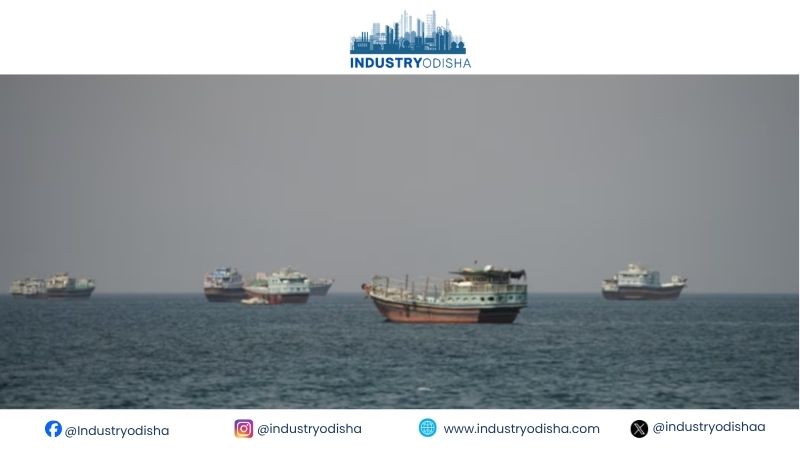
Industry Odisha Bureau, Sep11: Vessel transits through the Strait of Hormuz fell to seven on Thursday. The decline highlights growing pressure on global energy trade. Bab el-Mandeb traffic also faced fresh Red Sea tensions.
Shipping traffic through the Strait of Hormuz has fallen to unusually low levels. The Iran war continues to reshape global energy trade. Vessel movements offer an early signal of shifting Gulf shipping dynamics.
Hormuz vessel traffic falls sharply
Vessel transits through the Strait of Hormuz fell to seven on Thursday. That is down from 11 the previous day, preliminary ship tracking data showed. The reported 10-day average stood at 15 vessels. Ship tracker Kpler recorded the figures as of 0306 GMT. Two Panamax vessels exited the strait during the day. One carried fertiliser, while the other sailed in ballast. Five vessels entered, spanning several vessel categories. They included a Panamax carrying dry bulk cargo. A Handysize vessel carried steel, another carried grains. A medium-range tanker moved dirty petroleum products. A Supramax vessel carried additional dry bulk cargo.
Why the Strait of Hormuz matters
The Strait of Hormuz links Persian Gulf producers with world markets. Before the Iran war began, traffic was far higher. The strait typically handled around 125 large commercial vessels daily. These included tankers, gas carriers, bulkers and container ships. Kpler data suggests the waterway carries roughly 20% of daily global crude and LNG supply. Thursday’s mixed cargo list, from fertiliser to grains, underlines Hormuz’s wider commercial role. The strait is not solely an oil corridor.
AIS tracking has limits
Ship tracking figures rely on Automatic Identification System transponders. Some vessels can switch off AIS to avoid detection. Recorded traffic therefore may not capture every crossing. Analysts treat the numbers as preliminary, not final counts. Seven vessels reflect tracked transits, not a definitive total. The gap between recorded and actual transits remains unclear.
Iran war reshapes Gulf shipping
The Iran war started on February 28, according to the report. Shipping patterns have shifted considerably since then. A US blockade of Iran-related shipping resumed in mid-July. Iranian crude oil exports have reportedly halted since then. The blockade adds further pressure on regional energy flows.
Bab el-Mandeb sees modest Red Sea pressure
Iran-aligned Houthis seized Yemen’s port city of Mocha on Thursday. Military sources said forces advanced along the Red Sea coast. Reports pointed to movement towards strategic islands nearby. Bab el-Mandeb recorded 26 commodity vessel movements the same day. Ten vessels entered the strait, while sixteen exited. That compares with a 10-day average of around 27 ships. The decline there was slight, not dramatic.
Two chokepoints, one uncertain outlook
Hormuz and Bab el-Mandeb serve different trade routes. Both remain vital for global energy and commodity shipping. Simultaneous pressure on each waterway adds to maritime uncertainty. Hormuz traffic remains well below recent norms. Bab el-Mandeb movements stay closer to typical levels. Further developments could still affect vessel scheduling and energy deliveries. Energy markets are likely to track vessel counts for signs of change. Both chokepoints will likely stay under close watch.
