



Industry Odisha Bureau, Oct 07: India’s B2B apparel market has more than doubled in five years to $2.1 billion. Factories still drive most uniform demand. The gig economy adds new demand, where uniforms double as brand identity.
Watch any busy Indian street and the change is easy to spot. Branded jackets weave through traffic on delivery bikes. Technicians in company shirts ring doorbells to fix appliances. Work clothing that once stayed inside factories now travels through neighbourhoods. For India Inc, how staff dress has become a commercial decision.
A $2.1 billion market
India’s B2B apparel market has more than doubled in five years to $2.1 billion. That is according to a CMAI-1Lattice report. B2B apparel covers uniforms and workwear bought by companies, institutions and government agencies. Buyers range from defence and healthcare to factories, hotels, retailers and transport firms.
Factories still lead
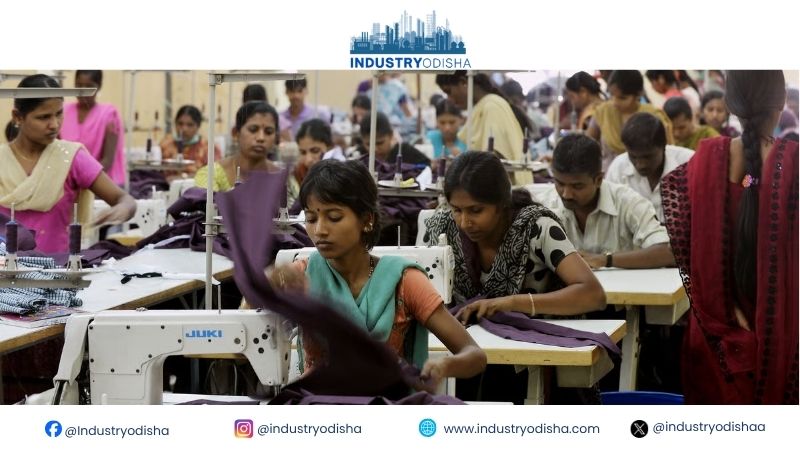
Traditional buyers remain the backbone of demand. Industrial and manufacturing units form the largest segment, at an estimated ₹4,800 crore. Hospitality follows at ₹2,900 crore, with internal security at ₹2,200 crore. Defence and paramilitary forces account for ₹1,755 crore. Private security guards add another ₹1,050 crore.
Safety meets image
Santosh Katariya, president of the Clothing Manufacturers Association of India, sees two forces at work. Factories are becoming more safety-conscious, driving demand for controlled, protective clothing. At the same time, businesses want their staff to look smarter. A well-made uniform helps a company project a consistent brand image, he said.
Gig work changes the customer
The newer growth driver is India’s gig economy. Delivery riders, ride-hailing drivers and home-service professionals now represent companies in public. For these businesses, the worker at the door is the physical face of the brand.
India had more than 6 million active monthly gig workers in 2025, according to Redseer. They span delivery, ride-hailing and home services. Redseer projects the workforce could reach 17–21 million by 2030. Delivery is the largest segment, with about 2.4 million workers in 2025. Home services had about 100,000.
The work stretches across food delivery, quick commerce, ecommerce logistics, repairs, plumbing and cleaning. Each role creates potential demand for shirts, jackets and identifying workwear. A larger frontline workforce widens the customer base for uniform makers.
A signal at the door
Identification matters most when workers enter customers’ homes. Garima, vice-president of supply chain at Flipkart, says uniforms give workers a sense of identity. For consumers, they offer a simple assurance of who the worker represents, she said. A uniform signals affiliation, though it is not proof of identity on its own.
Factory workwear rarely left the shop floor. Gig-economy clothing, by contrast, moves through streets and neighbourhoods. In effect, it works like a moving billboard for digital brands.
Small slice, bigger pie
B2B apparel remains a small part of India’s clothing industry. The overall apparel market was worth $95.7 billion in 2025. It has grown from $68.5 billion in 2019. The report projects $146 billion by 2029, implying about 9% annual growth.
For manufacturers, the uniform opportunity looks different from fashion. Corporate buyers need standardised orders, customisation, consistent quality and repeat supply.
Workwear follows work
India’s jobs are increasingly spread beyond offices and factory floors. Work now happens on roads, in homes and across logistics networks. The uniform is following workers there. That shift is steadily reshaping demand for B2B apparel.
