


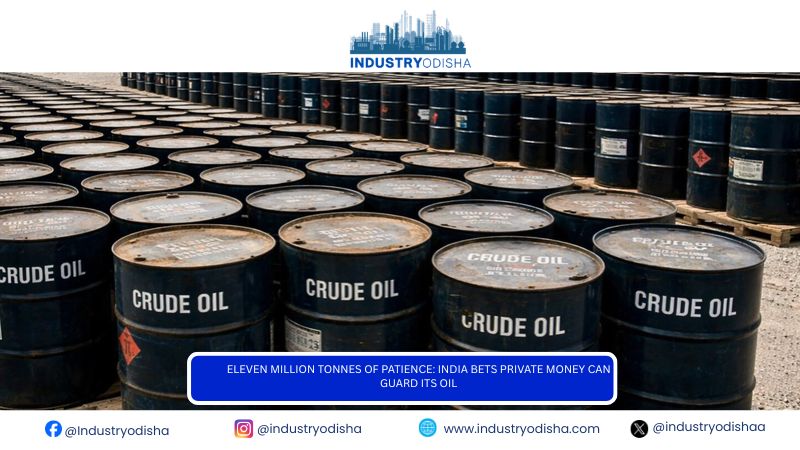
Industry Odisha Bureau, Jul 24: Crude oil held in a strategic reserve does nothing. It sits in the dark, hundreds of feet below ground, earning no return and moving no markets, waiting for a crisis that may never arrive. That is the entire point of it. And it is precisely why the next chapter of India’s Strategic Petroleum Reserve programme is being written differently from the first.
The government intends to build two more commercial-cum-strategic storage facilities under a public-private partnership, at an estimated cost of ₹14,527 crore. State support in the form of viability gap funding has been capped at 60% of that figure — calibrated to make the project financeable without turning it into a public works exercise. Suresh Gopi, Minister of State for Petroleum, laid out the structure in a written reply to the Lok Sabha.
The hyphenated label attached to these sites — commercial-cum-strategic — is where the real shift hides. Tankage that can be leased to traders and refiners between emergencies earns money. Tankage held purely as a national buffer does not. Japan and South Korea have run hybrid models for decades, blending government stock with industry-held and leased inventory; Seoul has actively marketed spare capacity to international oil majors. India is edging toward the same arithmetic.
Built once, the expensive way
The reserve that exists today was constructed entirely on the state’s account. Indian Strategic Petroleum Reserve Ltd, the special-purpose vehicle under the petroleum ministry, holds 5.33 million metric tonnes across three coastal sites — 1.33 MMT at Visakhapatnam on the Bay of Bengal, 1.5 MMT at Mangaluru and 2.5 MMT at Padur on the Arabian Sea. Construction and commissioning ran from 2016 to 2018.
The technology is old, proven and deliberately unglamorous. Crude is stored in unlined rock caverns excavated below the water table, where groundwater pressure alone keeps the oil sealed in place. It costs less per tonne than steel tank farms, shrugs off cyclones, presents almost nothing to target from the air, and suits a commodity meant to sit still for years. The United States uses solution-mined salt domes along the Gulf Coast on the same principle.
Where you put a cavern matters as much as how you dig it. A reserve is only as good as the speed with which its contents reach a refinery gate, which is why all three Indian sites sit within reach of deepwater ports, crude receiving terminals and existing pipeline links.
The next 6.5 million tonnes
Cabinet approval for the expansion came in July 2021: 4 MMT in Odisha and 2.5 MMT in Karnataka, adding 6.5 MMT to the national buffer. The publicly identified locations are Chandikhol in Odisha and a further build-out at Padur.
The split tracks the geography of Indian refining, which straddles both coasts and has tilted eastward as crude arrives from West Asia, West Africa and — since 2022 — Russia through different terminals. Odisha pushes coverage north along the eastern seaboard, closer to refineries there and to the industrial demand of the mineral belt. Adding capacity at an existing Karnataka site brings the ordinary advantages of brownfield work: land secured, geology understood, port connection already in place.
Gopi told Parliament that assessment of further sites is a continuous process — language suggesting the programme is not meant to stop at Phase-II.
Still short of the global bar
Even completed, the numbers stay modest. Roughly 11.8 MMT across both phases translates into weeks of import cover, not the 90 days of net imports that International Energy Agency members are required to hold. India participates as an association country rather than a full member, and has pushed for closer alignment with the agency for years — a diplomatic thread running alongside the physical construction.
Refinery inventories and crude in transit supplement the strategic stock, and officials routinely cite the combined figure. But only the strategic portion is something a government can actually order into the market on a Tuesday morning.
India has already shown what that is worth. When prices collapsed in the spring of 2020, the country filled its caverns cheaply — a reminder that storage capacity pays off on the buying side as often as the drawing side.
What the market will want to know
Whether developers turn up depends on details not yet in public view: concession length, the rules governing commercial use of the tankage, the mechanism by which the state can requisition barrels in an emergency, and how fast land and clearances materialise. Infrastructure investors know VGF-backed roads and ports intimately. Underground crude caverns are a rarer asset — long build cycles, and revenue that leans on trading demand no government can promise.
The strategic logic, meanwhile, keeps getting stronger. India’s crude arrives through some of the most contested water on the planet, import dependence climbs with demand, and the price shocks of the past four years have come from wars and sanctions rather than from anything a supply-demand model was designed to predict.
Buried oil is a wager that the disruption comes. What is new in Phase-II is who India wants standing beside it when the bet is placed.
