


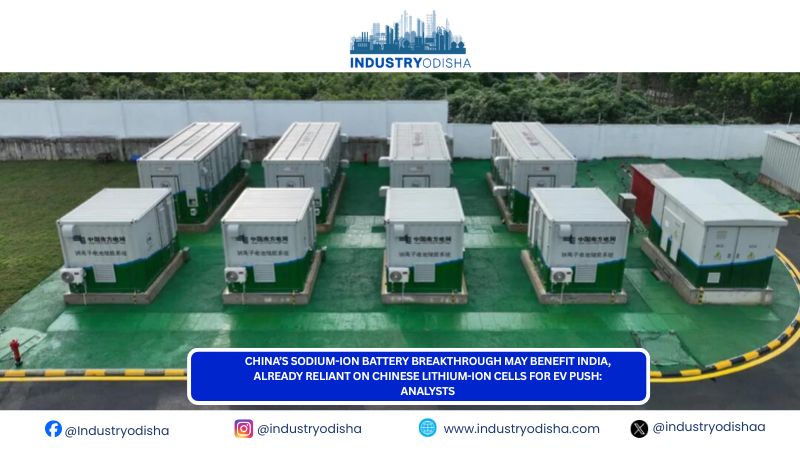
Industry Odisha Bureau, Aug 3: Since China is reportedly racing ahead with its sodium-ion battery breakthrough’s commercial use for Electric Vehicles (EVs) and energy storage, analysts have reportedly opined that it could help India as the country is already heavily relient on inporting Chinese lithium-ion batteries for its ongoing EV push.
Media reports, citing opinions of analysts, have stated that, “India heavily imports lithium-ion batteries from China, with around 75% of its battery imports in 2023-24 sourced from Chinese manufacturers. India’s Electric Vehicle (EV) and energy storage sectors are significantly dependent on Chinese lithium-ion battery imports. In 2024-25, imports of lithium-ion cells from China amounted to approximately USD 2.2 billion, and major Indian EV manufacturers, including Tata Motors, source cells from Chinese companies like Gotion and EVE. Overall, India’s domestic demand for lithium-ion battery materials is fully met through imports, leaving the sector exposed to global supply disruptions.”
Media reports, citing opinions of analysts, have also added that, “Key importers of lithium-ion battery are Dell International Services India, Tata Autocomp Systems, Navitasys India, and Times Logistics Trading Company, et al. Between June 2024 and May 2025, India imported nearly 39,710 shipments of lithium batteries, with China being the largest source, followed by Vietnam and Japan.”
Nevertheless, India has reportedly initiated policy and strategic measures “to reduce reliance on imports by increasing customs duties on lithium-ion batteries from 10% to 20%, incentivizing domestic production under initiatives like the Production-Linked Incentive (PLI) scheme. Indian companies are also exploring alternative technologies, such as sodium-ion and solid-state batteries, to enhance supply chain resilience and reduce dependency on Chinese imports.”
Drawing a comparison between the lithium-ion batteries and sodium-ion counterparts, experts have reportedly cited that, “Sodium-ion batteries offer lower cost, higher safety, and better cold-weather performance, while lithium-ion batteries maintain superior energy density and range, making them complementary technologies in China’s EV and energy storage markets.”
In India’s context, media reports citing opinions of analysts have claimed that, “Reliance Industries Ltd, Tata Group, INDI Energy, KPIT Technologies, GODI Energy, Exide Industries and Ola Electric are among the Indian companies that have outlined plans to develop sodium-ion batteries. Reliance Industries strengthened its ambitions by acquiring UK-based battery startup Faradion for £100 million, aiming to commercialize the technology. But, commercial-scale production has yet to materialize.”
