



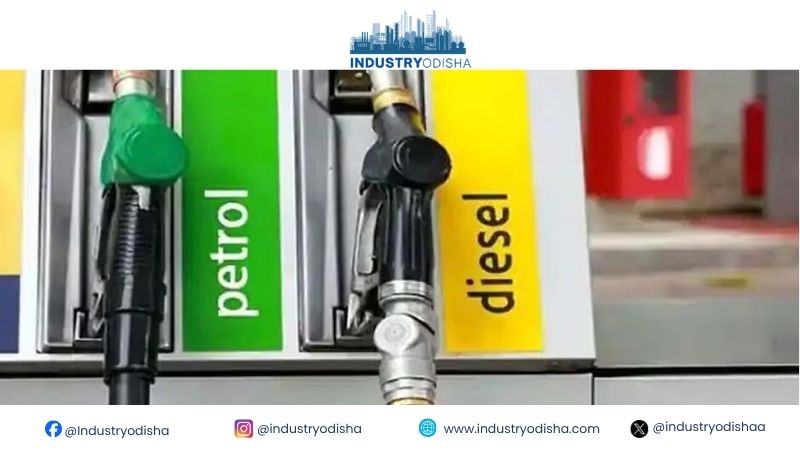
Industry Odisha Bureau, Oct 03: Nayara Energy raises petrol prices by ₹5 a litre and diesel by ₹3. Rising crude and refined-product costs drove the move. State-owned retailers have largely held pump prices steady.
India’s fuel retailers are starting to follow different pricing paths. State-owned companies have largely kept pump prices steady despite rising global costs. Nayara Energy, India’s largest private fuel retailer, has now broken ranks. The move exposes growing strain beneath the country’s stable retail fuel market.
Nayara moves first
Nayara Energy has raised its petrol price by ₹5 per litre. Its diesel price has risen by ₹3 per litre. People familiar with the matter confirmed the revision. The new rates took effect early on Saturday across its 7,108 fuel stations. The company did not respond to an email seeking comment.
The increase follows higher international crude oil and refined-product prices. Nayara also operates a 20-million-tonne-a-year refinery at Vadinar, Gujarat.
Not the first attempt
This is not Nayara’s first attempt to pass on rising costs. It raised petrol and diesel by the same amounts on March 26. That move followed energy-supply disruptions linked to the Iran conflict. Nayara reversed the increase on July 1, after crude prices fell. West Asian tensions had eased by then.
State retailers hold their ground
Indian Oil Corporation, Bharat Petroleum and Hindustan Petroleum dominate the market. Together, state-owned retailers control more than 90% of India’s 1,04,137 petrol pumps. They have generally kept retail prices stable despite global crude fluctuations. Their prices therefore shape what most Indian motorists pay.
Nayara’s increase could widen the gap between private and state-owned outlets. Consumers may now pay different prices depending on which pump they use.
Margins turn negative
The pressure is clearly visible in marketing margins. Icra estimated that oil marketing companies faced negative margins in September. The shortfall was about ₹8 per litre on petrol. On diesel, it was about ₹9 per litre. In simple terms, retailers earned less than their costs on each litre sold.
The rating agency estimated losses of around ₹530 crore a day. That figure covers petrol, diesel and LPG together. Icra linked it to higher crude prices and unchanged domestic fuel rates. It said both profitability and cash flows were affected.
The break-even problem
Icra also outlined a break-even range for the sector. Combined refining and marketing operations break even with crude at $85–$90 a barrel. That range is a threshold, not the current crude price. Above it, unchanged pump prices could push retailers into marketing losses.
Supply strains emerge
Supply patterns have added further strain for private retailers. Nayara and Jio-bp had limited fuel volumes at some pumps amid retail losses. On October 1, the government said private retailers should not restrict sales. Officials also pointed to a gap between bulk and retail diesel prices. Industrial buyers turned to cheaper retail outlets, increasing pressure on supplies.
Jio-bp holds for now
Jio-bp, the joint venture between Reliance Industries and UK-based bp, has taken a different route. It operates 2,304 petrol pumps. It has not changed petrol or diesel prices so far.
The gap becomes the story
Nayara’s move shows how rising global costs are testing retail fuel economics. If other retailers follow, freight charges and operating expenses could rise. Household inflation and fuel demand could also feel the effect. For now, the bigger story is the widening gap between private and state pumps.
