



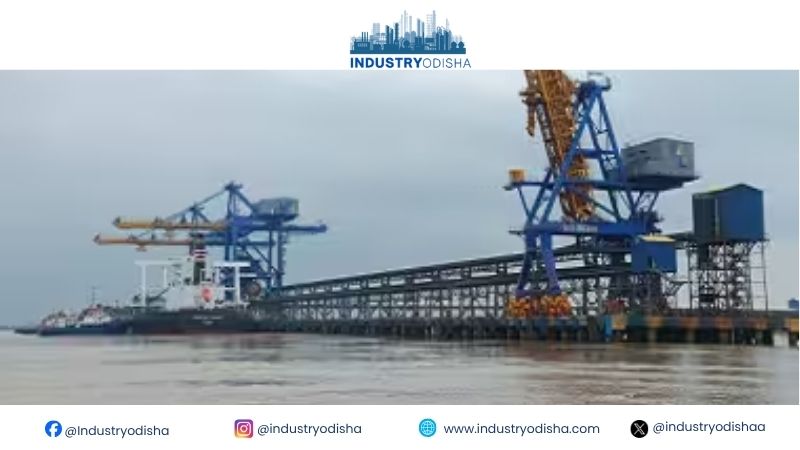
Industry Odisha Bureau, Sep 27: Dhamra Port now sources all its electricity from renewable power. That covers more than 90 lakh units every month. The shift cuts electricity-linked emissions, but wider port decarbonisation remains unfinished.
Every month, Dhamra Port in Odisha draws more than 90 lakh units of electricity. Since August 2026, all of it has come from renewable sources. On an annualised basis, that consumption exceeds 108 GWh.
Operator Adani Ports and Special Economic Zone (APSEZ) calls this a national first. According to APSEZ, Dhamra is India’s first large private multi-cargo port on fully renewable electricity. That claim comes from the company and has not been independently verified.
Where Dhamra’s renewable power comes from
Dhamra does not rely on a single renewable source. Around 25-30% comes from APSEZ’s captive hybrid power plant at Khavda, Gujarat. Another 10-15% arrives through third-party access arrangements. The rest flows through a Green Consumer arrangement with Odisha’s distribution utility.
The shift concerns how Dhamra sources power, not where it generates it. Running on renewable electricity is different from producing that electricity on-site. A round-the-clock port needs steady supply. Spreading procurement across three routes can support renewable sourcing through day and night. It does not, by itself, guarantee uninterrupted power.
A port moving nearly 49 million tonnes
That electricity serves a heavy industrial operation. Dhamra has an installed capacity of about 60 million tonnes (MT). It handled 48.8 MT in the financial year ended March 2026.
Six dry-cargo berths work alongside rapid-loading silos and wagon tipplers. Track hoppers, mechanised storage yards and jetty equipment complete the chain. These systems move bulk cargo between ships, storage and railway wagons. Renewable power now supports cargo handling, storage and rail-linked activities. It does not mean every machine at the port runs on electricity. Nor does it cover the ships that call there.
Only one layer of emissions
The main gain lies in Scope 2 emissions. These are indirect emissions tied to purchased electricity. Replacing conventional power with renewable supply can reduce that category.
Other sources remain outside its reach. Diesel equipment, trucks, locomotives and vessels can still generate emissions. Construction and other fossil-fuel use add further layers. A port running on renewable electricity is not a zero-emission port.
Eastern India’s logistics link
Dhamra sits on the Odisha coast between Haldia and Paradip. Rail and road links connect it to mineral-rich regions. These span Odisha, Jharkhand and West Bengal.
Goods move from industrial hinterlands by rail and road to the port. From there, they enter maritime trade. Cleaner electricity at such a node trims one emissions source in long supply chains.
The next decarbonisation test
Green ports in India face a harder task beyond electricity. Globally, ports are weighing equipment electrification, shore power and cleaner transport. Energy efficiency, storage and alternative marine fuels also form part of that toolkit.
Dhamra’s model blends captive, third-party and regulated green supply. Electricity rules differ between states, so replication elsewhere is not straightforward.
The power question at Dhamra now has an answer. The tougher test lies in the engines, locomotives and vessels around it.
