


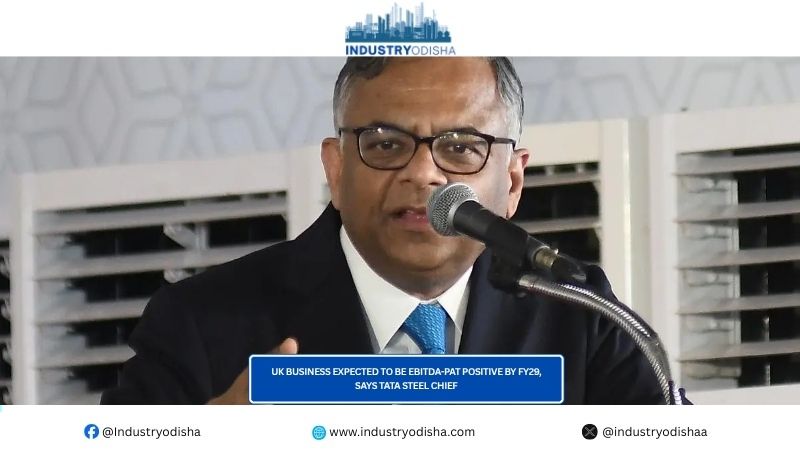
Industry Odisha Bureau, Jul 3: Tata Steel Chairman N. Chandrasekaran reportedly said yesterday that the company’s business in the United Kingdom (UK) is expected to become EBITDA-PAT positive by FY29 when the electric arc furnace (EAF) project would be completed there.
Addressing the shareholders at Tata Steel Ltd.’s annual general meeting (AGM), the Chairman reportedly said, “We hope to stem the losses, and this (EAF) project will be completed in FY29. At that time, the company should not just be EBITDA positive, it should also be PAT positive. That is the target that we have for the UK.”
Media reports stated that, “the revised FY29 deadline replaces the FY26 profitability goal Tata Steel Chairman N. Chandrasekaran had set for Tata Steel Chief Executive and Managing Director T.V. Narendran at last year’s AGM.”
Quoting the Tata Steel Chairman, media reports said, ““There were a lot of questions about international operations and Europe and the UK and Canada and all these operations. See, this has been an issue that we have been trying to tackle for a number of years now. We have tackled it to some extent by increasing the Indian capacity significantly now.”
Media reports also quoted the incumbent Tata Steel Chairman stating that, “India has become the company’s ‘primary cash engine’, with domestic EBITDA increasing from just over Rs 10,000 crore to around Rs 30,000 crore over the past decade, providing the cash generation needed to support its international restructuring efforts.”
Notably, “A positive EBITDA and PAT indicate that a company is generating profit from its core operations and has a net profit after all expenses and taxes. Therefore, it is essential to consider both EBITDA and PAT positive in the context of a company’s overall financial health and future prospects.”
Similarly, “The positive difference between EBITDA and PAT is significant as it indicates a company’s operational profitability. While EBITDA measures a company’s earnings from its core business operations before accounting for financial structure and non-cash accounting expenses, PAT represents the final net profit after all expenses are deducted. The difference reflects how efficiently a company generates profit from its core operations, independent of capital structure and accounting decisions.”
