


Industry Odisha Bureau, Sep 24: New GOBARdhan rules give compressed biogas producers assured demand and decade-long pricing. Corporate investment is following. Pipeline gaps and patchy feedstock still stand between policy and scale.
India’s compressed biogas producers finally know who will buy their gas, and at what price. GOBARdhan rules issued on September 15 settle both questions. The Rs 23,731 crore scheme, running FY2026-27 to FY2035-36, targets nearly tenfold CBG growth.
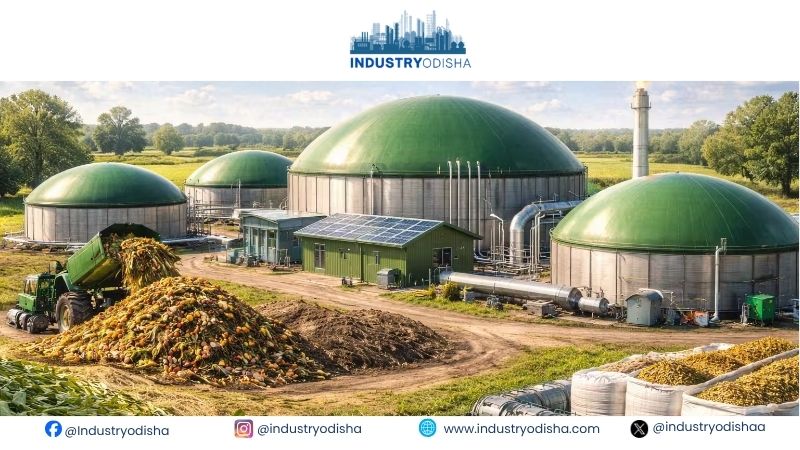
CBG is cleaned, compressed gas from cattle dung, crop waste, press mud and municipal waste. It can replace imported natural gas, strengthening energy security.
Assured Offtake and CBG Blending Create Demand
SATAT, launched in October 2018 and now merged into GOBARdhan, stalled on demand. By October 2022, 3,694 letters of intent had yielded only 38 commissioned plants.
Producers may now seek assured offtake for up to 100% of saleable gas. This remains subject to technical and operational feasibility.
City gas distribution companies must source 3% CBG in FY2026-27. It rises to 4% in FY2027-28 and 5% from FY2028-29. GAIL pools the gas under three-way contracts with producers and CGD firms. CGD firms slow to sign deals may lose cheaper government-priced gas.
A Fixed CBG Price Until 2036
The CBG price is fixed at Rs 2,110 per MMBTU until March 31, 2036. That is roughly Rs 98 per kg, before taxes and compression charges. It is more than 40% above the earlier Rs 1,478 benchmark.
For ten years, GAIL can draw up to Rs 10 per kg to bridge price gaps. A fixed selling price, however, does not fix operating costs.
Capital Subsidy Tied to Performance
New plants receive Rs 1.25 crore per tonne of daily capacity. A collection-machinery component reimburses up to half, capped at Rs 0.75 crore per tonne. Older biogas plants upgrading to CBG get Rs 0.60 crore per tonne. Each project is capped at Rs 30 crore. Staged, output-linked payments put bank guarantees at risk for underperformers.
Petronet LNG Makes a Biogas Investment Call
On September 17, Petronet LNG approved a 50:50 venture with Gruner Renewable Energy. They plan 10 CBG plants of 18 tonnes daily each. The estimated outlay is Rs 1,200 crore, about Rs 120 crore per plant. India’s largest LNG importer is thus backing home-grown gas.
At full output, one plant could earn roughly Rs 64 crore a year from gas. That is gas revenue, not profit, before manure income, taxes and running costs.
Pipeline Connectivity Is the Binding Constraint
In April, only 17 of 207 commissioned plants had pipeline connections. The gas regulator flagged infrastructure readiness as the key shortfall. Trucking gas in high-pressure cylinders is costly. The scheme adds a pipeline component and routes plant clusters into trunk lines.
Feedstock adds risk: crop waste is seasonal, scattered and needs storage. Erratic supply can idle costly plants.
Ethanol’s Learning Curve Offers Context
Ethanol blending stood near 1.5% in 2014, 13 years after the 2001 pilot. Wider feedstock, dated targets, assured purchases and finance then changed its learning curve. Output rose from 38 crore litres to 661 crore litres by 2025. Blending reached 20%, five years ahead of the 2030 target.
Biogas now holds similar tools, but that guarantees no similar outcome.
India has removed several uncertainties that stalled its biogas investment case. Pipeline connectivity, feedstock reliability and plant execution remain unresolved. The next few years will show whether policy certainty delivers physical scale.
