



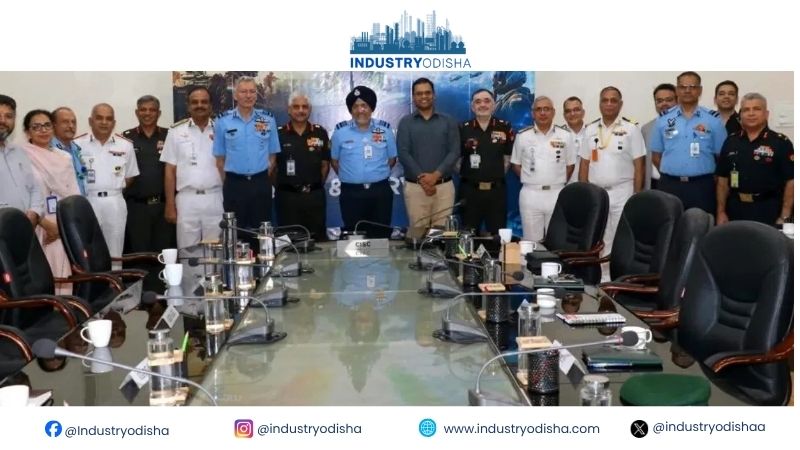
Industry Odisha Bureau, Oct 27: A new MoU gives India’s three armed Services one shared AI framework. Timelines, funding and deployment details are yet to be disclosed.
Sarvam has signed an MoU with the Ministry of Defence to build military AI. The pact is with Headquarters Integrated Defence Staff, known as HQ IDS. It was announced on October 27, 2026. The agreement sets up one umbrella framework for AI projects across all three Services. It covers the Indian Army, the Indian Navy and the Indian Air Force. Joint, tri-service and integrated organisations under HQ IDS also fall within its scope.
The significance lies less in any single project than in the structure. Instead of each Service building its own tools, all draw on common AI systems. That design choice could shape how India’s military uses AI for years.
An MoU, however, is a framework for cooperation, not a purchase order. It does not by itself confirm contracts, budgets or battlefield deployment. No financial value, timeline or project list has been made public. Those details will decide how much of the plan becomes real.
Under the agreement, Sarvam will design, develop and deploy AI applications. These will serve the operational, training and decision-support needs of the Services. The company will also provide follow-on technical support after deployment. HQ IDS will facilitate the engagement, linking Sarvam with the Services’ requirements. The work spans several projects across all three Services, according to the announcement.
The core idea is a shared technology base. All three Services and the joint bodies will access the same foundation models. Foundation models are large AI systems trained on broad data and adapted to tasks. They will also share agentic infrastructure, which lets AI carry out multi-step tasks. Common geospatial and perception systems complete the stack. Geospatial tools analyse maps, terrain and imagery. Perception systems help machines interpret sensor inputs such as video or radar.
A shared stack offers a practical advantage. According to the announcement, doctrine and lessons from one Service’s projects can feed the next. A tool refined for the Army could then be adapted faster for the Navy. This could reduce duplicated effort and improve interoperability between the Services. It also fits HQ IDS’s mandate to promote jointness across the armed forces. Whether these gains materialise will depend on execution, not design alone.
The Ministry’s stated focus areas are decision support, target acquisition and data fusion. Data fusion here covers the sensor-to-shooter loop. That loop links detecting a threat to deciding on and executing a response. Sensors can include satellites, drones, radars and ground observers. Their data can arrive in different formats and through different channels. AI could combine these feeds faster and present a clearer picture to commanders. In planning and training, AI could help analyse scenarios and simulate operations.
Crucially, human oversight will be retained on operational decisions. This principle matters most in target acquisition, where errors carry grave consequences. The announcement does not explain how oversight will be structured or audited. That question will shape public and legal confidence in the systems.
The work will be handled by Chanakya, Sarvam’s firewalled national security and defence division. Firewalling suggests separation from the company’s commercial business, though details are undisclosed. Chanakya will apply Sarvam’s AI stack, including foundation models such as Sarvam 105B. The name suggests a model with about 105 billion parameters. Its performance in military settings has not been publicly tested.
Co-founder Pratyush Kumar framed the deal around Sarvam’s national mission. “Sarvam exists to build AI in India, for India,” he said. He called working with the three Services on national defence an honour and a privilege. Kumar also thanked HQ IDS for its trust and pledged delivery for all three Services.
The MoU advances the Ministry’s direction for an indigenous military AI layer. The aim is AI built in India with Indian partners. It is also meant to run on sovereign infrastructure. For defence, this addresses real concerns about relying on foreign AI platforms. Foreign systems can raise risks around data control, supply disruption and hidden vulnerabilities. Still, sovereignty is a goal here, not an achievement. Building secure domestic computing capacity matters as much as building models.
Several important questions remain open. The announcement gives no timelines, investment figures or procurement plans. It does not say which projects come first or which Service leads. Testing standards and security certification processes are also not described. Field trials and deployment schedules are similarly unclear.
Integrating AI into military systems is difficult. Models must work reliably in contested, low-connectivity environments. They must resist cyberattacks and attempts to feed them misleading data. Large language models can also produce confident but wrong answers. New tools must connect with older platforms and existing command networks. Clear accountability is needed when AI-assisted decisions go wrong.
Sarvam and HQ IDS say they will pursue projects of critical national importance. These include an AI fabric connecting different elements of India’s defence capabilities. If delivered, it could give India one shared AI architecture across its forces. That would be a notable step for joint military modernisation. But the vision must pass rigorous testing, secure deployment and sustained funding first. Only then can a cooperation framework become an operational reality.
