



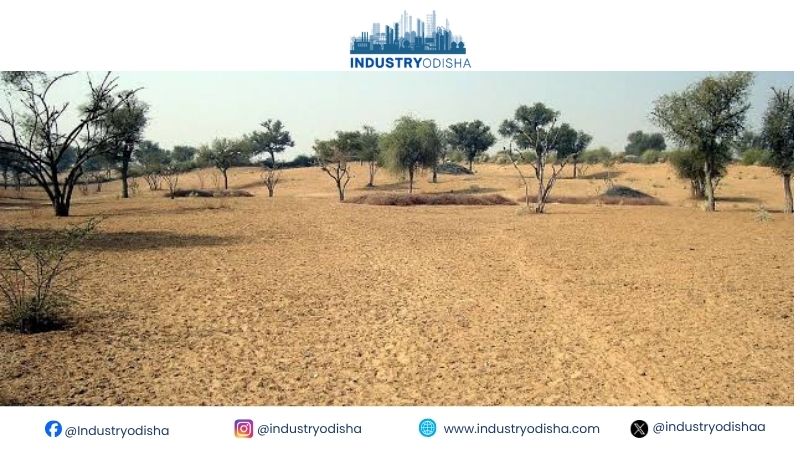
Industry Odisha Bureau, Oct 27: India’s green cover has shrunk by roughly a seventh since 2001, a new study finds. Where vegetation vanished, summers warmed, adding to India’s climate burden.
In 2001, vegetation covered nearly 37% of India’s land. By 2025, that share had fallen to 31.35%. Over the same years, Indian summers grew hotter.
A new analysis by Climate Trends, a climate research organisation, connects the two trends. The study tracked India’s land cover and summer temperatures across 25 years. Its central finding is simple. Where vegetation disappeared, summer temperatures rose.
The scale of loss needs careful reading. Green cover fell from 36.95% to 31.35% of the land surveyed. That is a drop of 5.6 percentage points. In relative terms, about 15% of 2001’s green cover vanished. In effect, India lost a slice of green equal to roughly a seventh of what it had. Non-green land, which includes built-up and sparsely vegetated surfaces, rose correspondingly. It climbed from 63.05% to 68.65%.
The study combined MODIS satellite land-cover data with ERA5 reanalysis temperature records. MODIS sensors aboard NASA satellites classify land surfaces from orbit. ERA5, produced for Europe’s Copernicus service, reconstructs past weather from observations and models.
This green cover is not the same as official forest cover. India’s forest surveys use different definitions and methods. Satellite classifications can also blur categories such as cropland, scrub and grassland. The findings describe broad patterns, not plot-level change. The full study was not available for independent review, so its figures rest on published reporting.
The heat gap
The temperature contrast is striking. Across the period, non-green surfaces ran 1–2.5°C hotter in summer than vegetated areas. That is a comparison between places at the same time. A separate finding tracks change over time. Regions that lost vegetation saw mean summer temperatures rise by 0.26°C.
The physics is well understood. Plants release water vapour through their leaves, a process called evapotranspiration. That uses solar energy that would otherwise heat the ground and air. Trees also provide shade and help soils retain moisture. Concrete, bare earth and dry scrub absorb more heat and release it slowly. Remove vegetation, and a landscape loses its natural cooling system. For millions, that means losing a measure of summer comfort.
Still, the study establishes a strong association rather than isolating cause. Greenhouse-gas warming is raising temperatures everywhere. The study itself found that green areas warmed too. Rainfall shifts, irrigation and urban growth also shape local temperatures. Vegetation loss appears to add heat on top of that wider warming.
The map of change is uneven. Losses concentrated in western India and the Indo-Gangetic Plain. Parts of central and peninsular India also lost cover. Gains appeared in pockets of the North-East and the Himalayan foothills. Scattered areas in southern and eastern India also turned greener.
Warming followed a different pattern. It was most pronounced in northwestern and northern India. Parts of central and southern India recorded localised cooling. These differences caution against treating India’s climate as one story. Northern India’s plains appear to face both pressures at once.
Who pays the price
The study arrives after a punishing year. IMD data shows August 2026 was India’s hottest August since 1901. Its mean temperature of 28.01°C beat the normal of 27.34°C. The monsoon ended 12.6% below its long-period average, the weakest since 2015. Five states have declared drought. The IMD linked the subdued monsoon to a strong El Niño.
Heat carries heavy economic costs. A 2019 ILO study projected India would lose 5.8% of working hours by 2030. That equals about 34 million full-time jobs, mostly in farming and construction. McKinsey has estimated lost labour could cost up to 4.5% of GDP this decade. Reporting on the study cited slightly different figures and sources. These projections cover heat broadly, not vegetation loss specifically.
The links to green cover are still real. Vegetation helps soil hold water and recharge groundwater. Shaded fields and streets reduce heat stress for outdoor workers. Cities with fewer trees trap more heat, especially at night. In a hotter summer, each lost hectare of green shifts more burden onto people.
Researchers involved framed vegetation as infrastructure. Dr Palak Balyan leads research at Climate Trends. She described vegetation as part of India’s climate-adaptation infrastructure, not just an ecological asset. She said protecting natural vegetation “should therefore be treated as an adaptation priority.”
Aarti Khosla, founder-director of Climate Trends, said temperatures had risen where green cover disappeared. She called that “a cost India’s communities are already paying for.”
Planting trees will not cancel climate change. Dr S K Dhaka, an atmospheric physicist at Delhi University, made that point. He said restoration can ease local heat stress. But “it should not be viewed as a substitute for broader climate action,” he warned.
He called for a dual strategy. First, prevent further loss of established vegetation. Second, restore green cover in the most heat-vulnerable regions. Alongside that, India needs stronger action on water management, urban planning and emissions.
The study’s own recommendations follow similar lines. It urges keeping existing vegetation and preventing unnecessary clearing. It also calls for ecological restoration as a core part of land management.
The distinction matters. Mature forests and grasslands may cool landscapes in ways young plantations cannot for years. Restoration must also suit local water and soil conditions. Otherwise, new planting can fail or strain scarce groundwater.
The vanishing vegetation of the past 25 years is not only an environmental loss. It is a quiet transfer of heat onto India’s farms, cities and workers. Each hotter summer raises the value of the green that remains. Protecting it may be among India’s most practical forms of climate adaptation.
