



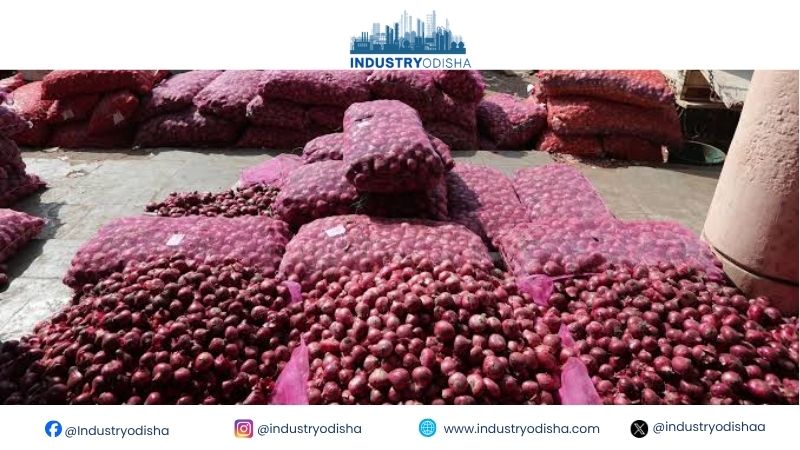
Industry Odisha Bureau, Oct 14: Onion prices more than doubled from a year earlier in September. Yet the harvest held steady and government buffer stocks were already moving to cities. Maharashtra’s mandi prices have since fallen nearly 14%.
India’s onion inflation hit 108.09% in September, provisional MoSPI data released on October 12 showed. Yet the price spike came without a failed harvest. Maharashtra’s mandi prices were already easing before the figure was published.
The two trends are not contradictory. The inflation rate compares September 2026 with September 2025, not recent weeks. Onion inflation stood at 48.78% in August.
The Agriculture Ministry’s June 11 estimates point to a steady harvest. Onion output for 2025–26 is projected at 307.37 lakh tonnes, against 307.67 lakh tonnes. That is a dip of about 0.10%. Cultivation area rose roughly 2.31%, implying marginally lower yields.
Potato production rose an estimated 2.25% to 598.89 lakh tonnes. Tomato output climbed about 4.19% to 214.61 lakh tonnes. Both remain cheaper than a year ago, at minus 11.50% and minus 8.62%. Their annual declines narrowed from August’s minus 13.15% and minus 31.09%.
Annual production, however, differs from what reaches markets at any moment. The rabi crop is stored and released gradually until fresh harvests arrive. Stored onions face moisture, sprouting, rot and weight loss, which can delay arrivals. Potatoes rely on cold storage, while perishable tomatoes react quickly to daily supply.
Government preparations began well before the inflation headline. Under the Price Stabilisation Fund, NAFED and NCCF started buying rabi onions on May 15. The 2026–27 buffer target was two lakh tonnes.
On July 4, the Department of Consumer Affairs raised the procurement price about 13%. It moved from ₹1,875 to ₹2,125 per quintal to improve farmer returns. By August 26, about 1.21 lakh tonnes had been procured. The Central Warehousing Corporation stored the buffer for the first time.
Calibrated releases began in late August to ease seasonal price pressure. By October 7, over 20,000 tonnes had reached 123 cities. Eight Kanda Express trains and 467 trucks moved the stock. Buffer onions sold at ₹35 a kilogram through NCCF, NAFED, Kendriya Bhandar and Safal outlets.
Rail movement has grown quickly. Rakes rose from 14 in 2024–25 to 86 in 2025–26. Volumes jumped from about 12,000 tonnes across five cities to roughly 88,000 tonnes across 16.
Maharashtra’s weighted average mandi price fell nearly 14% between September 16 and October 3. It slid from about ₹4,030 to ₹3,475 per quintal. Retail prices dropped by ₹1 to ₹21 a kilogram across 126 cities.
Kharif acreage is estimated about 5% higher than last year. Fresh kharif onions from Karnataka, Andhra Pradesh and Rajasthan are adding supply. Buffer releases and fresh arrivals may have helped, though their exact impact is unclear.
Part of the gap lies in how annual inflation is measured. A low price last September would magnify any yearly rise. Hypothetically, a move from ₹20 to ₹42 a kilogram exceeds 100%. The mandi data also covers one state’s wholesale trade, not national retail prices.
Easing prices may still leave onions costlier than a year ago. Markets will now watch kharif arrivals and Maharashtra’s mandi prices closely. Upcoming CPI readings will show whether recent relief reaches household budgets.
